Business
20 shipping companies shut operations in Nigeria
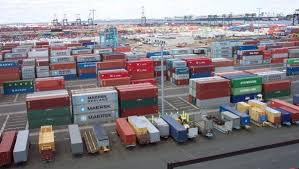
MARITIME Workers Union of Nigeria, MWUN, yesterday, said no fewer than 20 shipping companies, had shut operations in Nigeria due to unfavourable government’ policies, leading to the retrenchment of over 3000 workers in the last one year.
At a briefing, President-General of the union, Mr. Anthony Emmanuel Nted, among other things, lamented that the jobs of over 2000 workers were also on the line and called on President Muhammadu Buhari to intervene to save the sector from imminent collapse.
Nted contended that the recent increase in imports tariffs and ban on importation of essential commodities had forced shipping companion and importers out of business in Nigeria and relocated to neighbouring ports.
He called on President Buhari to immediately wade in and reduce the tariffs on importation of essential goods such as rice, cars, trucks’ wheat, motor spare parts, industrial machinery among others in the interest of the masses before things went out of hands. MWUN PG, argued that the ban on the goods had encouraged smuggling, diversion of ships to neighbouring countries, idle ports, retrenchment of workers, unemployment and general loss of revenue to government.
According to him: ” We wish to state that as a result of the government policies which banned the importation of some essential commodities into the country, about 3000 workers who are members of the Union have been by retrenched by shipping companies, terminal operators and logistics companies in the Maritime sector. Also, about 20 shipping companies have left the shore of the country because of low traffic.”
Nted who declined to name the affected shipping companies, saying they were verifiable in the ports, however warned that many more shipping companies were on the verge of leaving and were only doing skeletal services at the moment.

Continuing, he said:” Today, we lament the action of the management of Nigeria Ports Authority, NPA, in also planning to sack a section of the Dockworkers especially the Tally Clerks and Onboard Security men in spite of their importance and relevance in the Port operations, as it affects the reoccurring scourge of tonnage under declaration and its negative impact on the nation’s economy. The leakage of revenue through under declaration of tonnage should be seriously tackled. In this regard, we reiterate that Tally Clerks and Onboard Security men should be allowed to continue the critical job of uncovering and discouraging under tonnage which is often done with unholy collaboration of NPA, shipping companies, agents and terminal operators. The Tally Clerks and onboard security men are capable of preventing these economic crimes as they were doing through their independent and physical tallying process. Over 2000 workers(Tally clerks and onboard security men) are involved. Their reinstatement will go a long way in reducing the number of unemployed Nigerians, and also reducing the misery of their families.”
The union demanded among others that “All access roads to the ports as a matter of urgency, should be expanded and rehabilitated to handle cargo traffic in our ports. The traditional rail operations in our seaports should be restored to reduce the pressure on our highways and daily fatal accidents and deaths from containers. Waterways should be developed for delivery of laden containers and heavy equipment through our coastal waters into the hinterland. The tank-farms which are now dangerously located close to the ports, residential areas and along the expressways and access roads close to the ports should be relocated far away from the seaports to starve-off the perennial gridlocks on the roads.
“The volume of vehicles imported into Nigeria through Nigerian ports has collapsed to an all-time low, with consequent loss of thousands of jobs in the maritime sector. The new duty regime for vehicles introduced since 2004 and application of the new rate of exchange for duty calculations have made the importation of cars and trucks into Nigeria far too expensive. In the last two years, the number of vehicles arriving Nigeria has shrunk by almost two third, while the volume of cars smuggled through Cotonou Border has continued to rise unabated. It is therefore necessary that the Federal Government reviews its stance on the Automative policy not to inflict any more suffering on the workers who are already having hard time with price increases every day.
“The Federal Government should look at making the importation of cars and trucks more competitive to enable the economy to grow. A significant reduction in the duties applicable on cars and trucks will go a long way to alleviating the challenges of our people and spurs economic activities. Government should as a matter of urgency adopt policies towards resuscitating the export of agricultural produces and mineral resources that were hitherto the main stay of Nigerian economy before the discovery of oil. This will no doubt create jobs in our seaports and increase revenue for the government.”
Business
FG earned N2.78trn from Company Income Tax in second quarter 2025—NBS
National Bureau of Statistics has said that Nigeria’s Company Income Tax rose sharply in the second quarter of 2025, hitting N2.78 trillion.
The figure represents a significant 40.27 per cent increase compared to the N1.98 trillion recorded in the first quarter of the year, reflecting both improved tax compliance and stronger corporate performance across key economic sectors.
The NBS report said that domestic company income tax payments accounted for the bulk of the revenue, contributing N2.31 trillion, while offshore collections stood at N469.36 billion during the period under review.
According to the NBS, the financial and insurance sector recorded the highest quarter-on-quarter growth, rising by an astonishing 772.29 per cent, driven by improved profitability among banks, fintechs, and insurance firms following robust half-year earnings.
This, according to NBS, was followed by wholesale and retail trade, as well as motor vehicle repair activities, which grew by 538.38%.
Activities of households as employers also surged by 526.79%, although their overall contribution to total company income tax remained negligible.
On the flip side, some sectors experienced sharp declines in company income tax remittances.
Activities of extraterritorial organizations and bodies dropped by –45.01%, while education, public administration, defence, and compulsory social security recorded declines of –26.61% and –18.17% respectively.
The contraction in these sectors, particularly education and public administration, highlights persistent structural and fiscal challenges confronting government-funded institutions.
In terms of contribution to total tax revenue, financial and insurance activities led with a dominant 44.13%, reflecting the sector’s continuing expansion and strong capital flows.
Manufacturing followed with 15.57%, bolstered by increased production output and improved supply chain activity.
Mining and quarrying ranked third, contributing 9.18%, supported by higher commodity prices and renewed interest in solid mineral development.
At the bottom of the contribution chart were activities of households as employers, which accounted for just 0.01%, as well as activities of extraterritorial organizations and bodies, and water supply, sewerage, waste management, and remediation services, each contributing 0.04%. Despite economic headwinds, year-on-year company income tax collection still rose by 12.66% when compared to Q2 2024, underscoring moderate but steady improvement in government revenue mobilisation.
Company income tax collection in the same period of 2024 rose by 150.83 per cent N2.47 trillion. In the first three months of the year, company income tax collection stood at N984.61 billion. According to the report, local payments in the period under review amounted to N1.35 trillion, while foreign CIT payments contributed N1.12 trillion. On a quarter-on-quarter basis, the agriculture, forestry, and fishing sectors exhibited the highest growth rate at 474.50%, followed by financial and insurance activities at 429.76%, and manufacturing at 414.15%.
Business
Lagos govt promises MSMEs continued visibility, market access
Lagos State government has reaffirmed its unwavering commitment to supporting micro, small, and medium enterprises (MSMEs) across the state through visibility, capacity building, and market access. Commissioner for Commerce, Cooperatives, Trade, and Investment, Folashade Ambrose-Medebem, made the pledge on Sunday at the closing ceremony of the 2025 Lagos International Trade Fair (LITF). The 38th edition of the event, organised by the Lagos Chamber of Commerce and Industry (LCCI), had its theme as “Connecting Business, Creating Value.”
Ms Ambrose-Medebem said every entrepreneur, regardless of scale, deserves an enabling environment to thrive and contribute meaningfully to the state’s economic prosperity. She said the state, through strategic investments in infrastructure, institutional reforms, and continuous engagement with the private sector, was building a Lagos that worked for business. The commissioner added that the state would continue to foster innovation, competitiveness, and sustainability.
“As a government, we remain steadfast in our commitment to making Lagos the preferred destination for commerce and enterprise. This fair has once again demonstrated the power of connection: connection between producers and consumers, investors and innovators, the government and the private sector, and local entrepreneurs and global brands. Every handshake, every conversation, every business card exchanged here is a building block toward the future we are creating, a future of prosperity that leaves no one behind,” she said.
The commissioner urged businesses to continue to connect, collaborate, and create value, saying, “In Lagos, we do not just trade goods; we trade ideas, build futures, and transform lives. “Together, let us continue to make Lagos not just a place of commerce, but a symbol of progress, innovation, and endless opportunity.” Gabriel Idahosa, president of LCCI, urged governments at all levels to continue addressing the issues of creating an enabling environment in the country.Mr Idahosa said focus should be on infrastructure, security, and implementing the right policies to address the key drivers of high inflation.
This, he said, was needed to fully harness the vast enterprising resources of domestic and foreign investors for the diversification of our economy and the welfare of our people. He pledged the commitment of the organised private sector to stand solidly behind the state in its quest to actualise its innovative initiatives on all fronts. NAN
Business
Jumia posts $17.7m pre-tax loss in Q3, down 1% in 12 Months
Jumia Technologies AG posts a $17.7 million loss before income tax in the third quarter of 2025, down 1% year-on-year from $17.8 million in the third quarter of 2024. The road to profitability has remained long as ecommerce continues to face uncertainties, including widening competition with rivals in the same industry. The e-commerce company revenue came in at $45.6 million compared to $36.4 million in the third quarter of 2024, representing a 25% year-over-year surge in the period. The company reported gross merchandise value of $197.2 million compared to $162.9 million in the third quarter of 2024, up 21% year-over-year. Excluding South Africa and Tunisia, physical goods GMV grew 26% year-over-year, Jumia revealed in the unaudited financials.
Jumia said in its report that the GMV growth was driven by supply and strong marketing execution, partially offset by lower corporate sales in Egypt. Excluding corporate sales, GMV in reported currency grew 37% year-over-year. Nigeria’s momentum accelerated, with order growth up 30% and GMV up 43% year-over-year, Jumia said. The e-commerce giant’s operating loss reduced by 13% year-over-year to $17.4 million compared to $20.1 million in the third quarter of 2024. The company’s adjusted earnings before interest tax depreciation and amortisation loss dropped by 17% to $14.0 million compared to $17.0 million in the third quarter of 2024.
Jumia reported a loss before income tax of $17.7 million, a slight reduction of 1% compared to $17.8 million in the third quarter of 2024. Liquidity printed at $82.5 million, a decrease of $15.8 million in the third quarter of 2025, compared to an increase of $71.8 million in the third quarter of 2024, which included the net proceeds from the August 2024 At-the-Market (ATM) offering, and a decrease of $12.4 million in the second quarter of 2025.
Its net cash flow used in operating activities settled at $12.4 million compared to net cash flow used in operating activities of $26.8 million in the third quarter of 2024 and $12.7 million used in the second quarter of 2025. The result includes a positive working capital contribution of $0.4 million.
Jumia reported that customers’ orders grew 34% year-over-year, driven by strong execution, enhanced product assortment, and healthy consumer demand across key categories. It said quarterly active customers ordering physical goods grew by 23% year-over-year, highlighting continued engagement and customer loyalty. As of September 30, 2025, the Company’s liquidity position was $82.5 million, comprised of $81.5 million in cash and cash equivalents and $1.0 million in term deposits and other financial assets, it said in the report Jumia’s liquidity position decreased by $15.8 million in the third quarter of 2025, compared to an increase of $71.8 million in the third quarter of 2024, which included net proceeds from the August 2024 At-the-Market (ATM) offering, and a decrease of $12.4 million in the second quarter of 2025.
Net cash used in operating activities was $12.4 million in the third quarter of 2025, compared to a net cash used of $26.8 million in the third quarter of 2024 and $12.7 million used in the second quarter of 2025. The result includes a positive working capital contribution of $0.4 million in the third quarter of 2025, compared to a negative working capital contribution of $9.1 million in the third quarter of 2024, primarily reflecting improvements in operating performance.
In addition, the Company reported $1.4 million in capital expenditures in the third quarter of 2025, compared to $0.9 million in the third quarter of 2024, primarily reflecting investments in infrastructure and facility enhancements to support business growth. “This quarter marks a significant acceleration in customer demand and order growth, driven by strong execution across our markets and growing consumer trust in the Jumia brand. We believe Jumia has reached an inflection point as our compelling value proposition, and improved operational discipline position us for sustainable, profitable growth.
“We continue to strengthen our cost structure and sharpen operational discipline, reinforcing our path toward profitability. Our focus remains on execution and customer engagement as we build a more efficient business.
“We believe that we are on track to reach breakeven on a Loss before Income tax basis in Q4 2026 and achieve full-year profitability in 2027, positioning Jumia for long-term growth and value creation.”
-
News3 days agoNigeria to officially tag Kidnapping as Act of Terrorism as bill passes 2nd reading in Senate
-
News3 days agoNigeria champions African-Arab trade to boost agribusiness, industrial growth
-
News3 days agoFG’s plan to tax digital currencies may push traders to into underground financing—stakeholders
-
Finance1 week agoAfreximbank successfully closed its second Samurai Bond transactions, raising JPY 81.8bn or $527m
-
Economy3 days agoMAN cries out some operators at FTZs abusing system to detriment of local manufacturers
-
News1 week agoFG launches fresh offensive against Trans-border crimes, irregular migration, ECOWAS biometric identity Card
-
News3 days agoEU to support Nigeria’s war against insecurity
-
Uncategorized3 days agoDeveloping Countries’ Debt Outflows Hit 50-Year High During 2022-2024—WBG