Finance
Interbank rate falls on matured T-bills, as stock index rises on bank shares gain
Nigeria’s interbank overnight lending rate fell sharply on Friday to an average of 12 per cent from around 60 per cent a week ago after the central bank repaid matured treasury bills and a refund of excess cash deposited by banks to buy dollars. In the same vein at the Nigerian Stock Exchange the main share index ended up 1.66 per cent at 36,920 points after bargain hunters returned to take positions in Guaranty Trust Bank and Zenith Bank, two top banks shunned early in the week over a disappointing interim dividend payout.
At the capital market GTbank shares rose 6.47 per cent to close at N39.50 while Zenith Bank gained 6.61 per cent to close at N24.53. The central bank sold $100 million at its special intervention auction in the foreign exchange market, which was less than the amount requested by banks, leading to a refund of the excess deposited by banks on Friday.
The regulator also injected about N168 billion in matured open market operation (OMO) treasury bills into the system on Thursday, raising money market liquidity levels. “The interbank rate is seen climbing again next week as the central bank resumes its aggressive liquidity mop up and sustains its intervention in the forex market,” one senior currency trader said.
The overnight lending rate jumped last week to as high as 100 percent intraday after the central bank tightened liquidity to support the naira currency. The regulatory bank has consistently issued OMO treasury bills to reduce excess liquidity in the money market and curb speculation on the local currency. The central bank sold a total of 68.79 billion naira worth of treasury bills on Friday in its bid to further tighten liquidity in the banking system. The bank’s sales on Friday amounted to 65.5 billion naira of 363-day open OMO treasury bills at 18.55 percent, and 3.29 million naira of the 174-day paper at 17.95 percent.
At the capital market the Nigerian stocks closed higher for the second consecutive day, lifted by shares in banking, cement and a consumer goods maker. The index of Nigeria’s top 10 banks gained 3.97 per cent to lift the index. The stock index had dropped to a 16-day low on Wednesday as some investors cashed in profits after recent gains.
The market had rallied for eight consecutive weeks and peaked at a 33-month high last week before profit takers took advantage of the gains. Other gainers include Dangote Cement, which accounts for a third of the market capitalisation. The cement firm was up 2.37 percent to close at 225 naira, FCMB Group rose 5.36 percent, PZ Cussons gained 4.99 percent while energy company Oando rose 3.94 percent.
Finance
Afreximbank successfully closed its second Samurai Bond transactions, raising JPY 81.8bn or $527m
African Export-Import Bank said it has successfully closed its second Samurai bond transaction, securing a total of JPY 81.8 billion (approx. USD 527 million) through Regular and Retail Samurai Bonds offerings.
The execution surpasses the Bank’s 2024 debut issuance size, attracting orders from more than 100 institutional and retail investors, marking a renewed demonstration of strong Japanese investor confidence in the Bank’s credit and its growing presence in the yen capital markets.
On 18 November, Afreximbank priced a JPY 45.8 billion 3-year tranche in the Regular Samurai market following a comprehensive sequence of investor engagement activities leveraging Tokyo International Conference on African Development (TICAD9), including Non-Deal Roadshows (NDRs) in Tokyo, Kanazawa, Kyoto, Shiga and Osaka, a Global Investor Call, and a two-day soft-sounding process which tested investor appetite across 2.5-, 3-, 5-, 7-, and 10-year maturities.
With market expectations of a Bank of Japan interest rate increase, investor demand concentrated in shorter tenors, resulting in a focused 3-year tranche during official marketing.
The tranche attracted strong participation from asset managers (22.3%), life insurers (15.3%), regional corporates, and high-net-worth investors (39.7%).
Concurrently, Afreximbank priced its second Retail Samurai bond on 18 November, a JPY 36.0 billion 3-year tranche, more than double the inaugural JPY 14.1 billion Retail Samurai issuance completed in November 2024.
The 2025 Retail Samurai bond also marks the first Retail Samurai bond issued in Japan in 2025.
Following the amendment to Afreximbank’s shelf registration on 7 November 2025, SMBC Nikko conducted an extensive seven-business-day demand survey through its nationwide branch network, followed by a six-business-day bond offering period.
The offering benefited from strong visibility supported by Afreximbank’s investor engagement across the country, including the Bank’s participation at TICAD9, where Afreximbank hosted the Africa Finance Seminar to introduce Multinational Development Bank’s mandate in Africa and its credit profile to key Japanese institutional investors.
MBC Nikko Securities Inc. acted as Sole Lead Manager and Bookrunner for both the Regular and Retail Samurai transactions. Chandi Mwenebungu, Afreximbank’s Managing Director, Treasury & Markets and Group Treasurer, commented:
“We are pleased with the successful completion of our second Samurai bond transactions, which marked a significant increase from our inaugural Retail Samurai bond in 2024, and which reflect the growing depth of our relationship with Japanese investors.
The strong demand, both in the Regular and Retail offerings, demonstrates sustained confidence in Afreximbank’s credit and mandate.
We remain committed to deepening our engagement in the Samurai market through regular investor activities and continued collaboration with our Japanese partners.”
Finance
Ecobank unveils SME bazaar: a festive marketplace for local entrepreneurs
Ecobank Nigeria, a member of Africa’s leading pan-African banking group, has announced the launch of the Ecobank SME Bazaar—a two-weekend festive marketplace designed to celebrate local creativity, empower entrepreneurs, and give Lagos residents a premium shopping experience this Detty December. The Bazaar will hold on 29–30 November and 6–7 December at the Ecobank Pan African Centre (EPAC), Ozumba Mbadiwe Road, Victoria Island, Lagos. Speaking ahead of the event, Omoboye Odu, Head of SMEs, Ecobank Nigeria, reaffirmed the bank’s commitment to supporting small and medium-sized businesses, describing them as the heartbeat of Nigeria’s economy. She explained that the Ecobank SME Bazaar was created to enhance visibility for entrepreneurs, expand market access, and support sustainable business growth.
According to her, “This isn’t just a market—it’s a vibrant hub of culture, commerce, and connection. From fresh farm produce to trendy fashion, handcrafted pieces, lifestyle products, and delicious food and drinks, the Ecobank SME Bazaar promises an unforgettable experience for both shoppers and participating SMEs. Whether you’re shopping for festive gifts, hunting for unique finds, or soaking in the Detty December energy, this is the place to be.” Ms. Odu added that participating businesses will enjoy increased brand exposure, deeper customer engagement, and meaningful networking opportunities—making the Bazaar a strong platform for both festive-season sales and long-term business growth. The event is powered by Ecobank in partnership with TKD Farms, Eko Marche, Leyyow, and other SME-focused organisations committed to building sustainable enterprises.
Finance
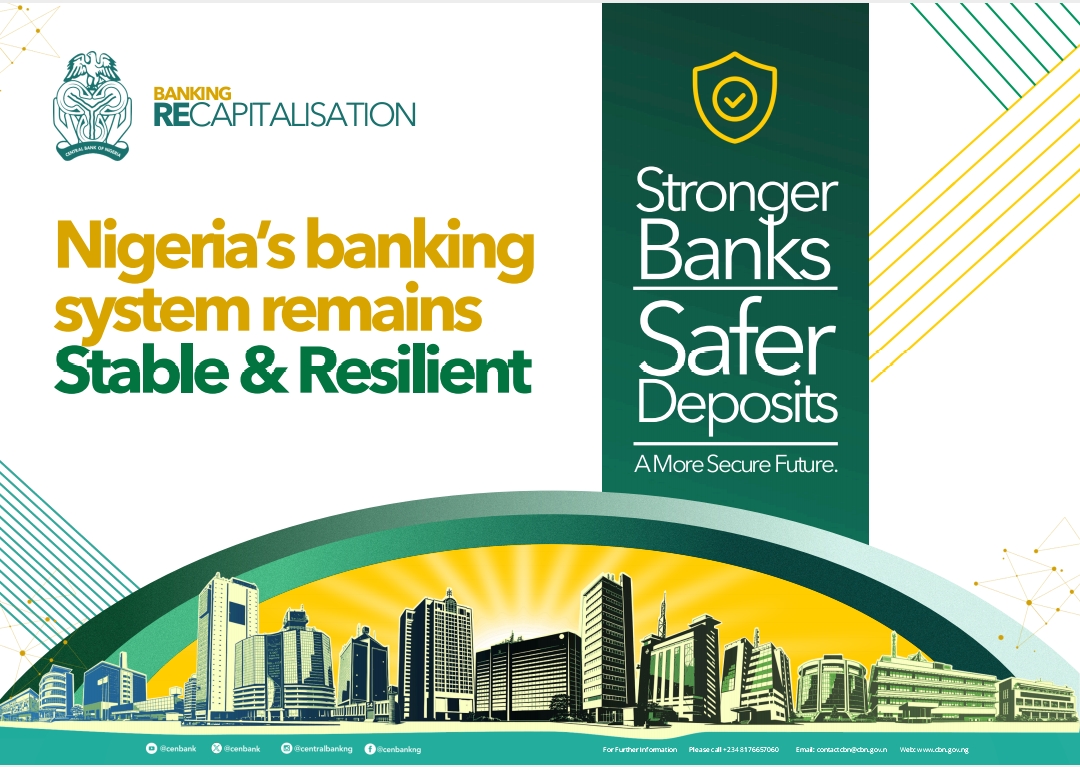
16 banks have recapitalised before deadline—CBN
The Central Bank of Nigeria (CBN) has said that16 banks have so far met the new capital requirements for their various licences, some four months before the March 31, 2026 deadline. The apex bank also indicated that 27 other banks have raised capital through various methods in one of the most extensive financial sector reforms since 2004. Addressing journalists at the end of the Monetary Policy Committee (MPC) meeting in Abuja, CBN Governor Mr Olayemi Cardoso said the banking recapitalisation was going on orderly, consistent with the regulator’s expectations. He said, “We are monitoring developments, and indications show the process is moving in the right direction.” Nigeria has 44 deposit-taking banks, including seven commercial banks with international authorisation, 15 with national authorisation, four with regional authorisation, four non-interest banks, six merchant banks, seven financial holding companies and one representative office.
Cardoso explained that eight commercial banks had met the N500 billion capital requirement as of July 22, 2024, rising to 14 by September of the same year. The number has now increased to 16 as the industry continues to race toward full compliance. He said that the reforms would reinforce the resilience of Nigerian banks both within the country and across the continent. “We are building a financial system that will be fit for purpose for the years ahead. Many Nigerian banks now operate across Africa and have been innovative across different markets. These new buffers will better equip them to manage risks in the multiple jurisdictions where they operate,” Cardoso said. According to him, the reforms would strengthen the financial sector’s capability to support households and businesses. He said, “Ultimately, this benefits Nigerians—our traders, our businesses and our citizens—who operate across those regions. “It should give everyone comfort to know that Nigerian banks with deep local understanding are present to support them. Commercial banks are also creating their own buffers through the ongoing recapitalisation.”
He added that the apex bank considered several factors in determining the new capital thresholds, including prevailing macroeconomic conditions, stress test results and the need for stronger risk buffers. He reassured on the regulator’s commitment to strict oversight as the consolidation progresses. “We will rigorously enforce our ‘fit and proper’ criteria for prospective new shareholders, senior management, and board members of banks, and proactively monitor the integrity of financial statements, adequacy of financial resources, and fair valuation of banks’ post-merger balance sheets,” Cardoso said. He said the CBN remained confident that the banking system would emerge stronger at the conclusion of the recapitalization exercise, with institutions better prepared to support Nigeria’s economic transformation Banks have up till March 31, 2026 to beef up their minimum capital base to the new standard set by the apex bank. Under the new minimum capital base, CBN uses a distinctive definition of the new minimum capital base for each category of banks as the addition of share capital and share premium, as against the previous use of shareholders’ funds.
While most banks have shareholders’ funds in excess of the new minimum capital base, their share premium and share capital significantly fall short of the new minimum definition. The CBN had in March 2024 released its circular on review of minimum capital requirement for commercial, merchant and non-interest banks. The apex bank increased the new minimum capital for commercial banks with international affiliations, otherwise known as mega banks, to N500 billion; commercial banks with national authorisation, N200 billion and commercial banks with regional license, N50 billion. Others included merchant banks, N50 billion; non-interest banks with national license, N20 billion and non-interest banks with regional license will now have N10 billion minimum capital. The 24-month timeline for compliance ends on March 31, 2026. Under the guidelines for the recapitalisation exercise, banks are expected to subject their new equity funds to capital verification before the clearance of the allotment proposal and release of the funds to the bank for onwards completion of the offer process and addition of the new capital to its capital base. The CBN is the final signatory in a tripartite capital verification committee that included the Securities and Exchange Commission (SEC) and the Nigeria Deposit Insurance Corporation (NDIC). The committee is saddled with scrutinising new funds being raised by banks under the ongoing banking sector recapitalisation exercise.
-
News3 days agoNigeria to officially tag Kidnapping as Act of Terrorism as bill passes 2nd reading in Senate
-
News3 days agoNigeria champions African-Arab trade to boost agribusiness, industrial growth
-
News3 days agoFG’s plan to tax digital currencies may push traders to into underground financing—stakeholders
-
Finance1 week agoAfreximbank successfully closed its second Samurai Bond transactions, raising JPY 81.8bn or $527m
-
Economy3 days agoMAN cries out some operators at FTZs abusing system to detriment of local manufacturers
-
News1 week agoFG launches fresh offensive against Trans-border crimes, irregular migration, ECOWAS biometric identity Card
-
News3 days agoEU to support Nigeria’s war against insecurity
-
Uncategorized3 days agoDeveloping Countries’ Debt Outflows Hit 50-Year High During 2022-2024—WBG