Maritime
ISPS CODE implementation: NIMASA reiterates commitment to best practices

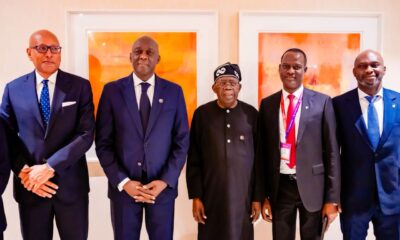
From left: Chief of Naval Staff representative, Rear Admiral Sunday A.G. Ababa, Board Chairman NIMASA, General Jonathan India Garba, Director General, NIMASA, Dr Dakuku Peterside and the House Committee Chairman on Maritime Safety and Education, Hon. Umar Mohamed Bago at the harmonized NIMASA Stakeholders Forum tagged: Synergy; An Instrument for Sustainable Development of the Blue Economy held at Eko Hotel, Lagos.
The United States Coast Guard (USCG) has expressed satisfaction at the compliance level of Nigeria with the International Ships and Ports Security (ISPS) facility Code at the nation’s ports. A delegation from the USCG led by Lt. Commander Jacob Hopper of the International Port Security (IPS) Liaison for USCG in West and Central Africa and Europe who were on a two-day visit to some of the ports in Lagos stated that there has been a lot of improvements in the nation’s port as a result of the security architecture put in place.
Speaking further, John Hopper commended the feat achieved by the Nigerian Maritime Administration and Safety Agency (NIMASA) which is the Designated Authority (DA) for the code in Nigeria and also noted that he was elated by the level of expertise and knowledge demonstrated by the NIMASA personnel during the visit.
While describing the NIMASA team as very resourceful, he charged the Agency not to rest on its oars in ensuring total compliance to the issues relating to safety and security at the nation’s ports.

Earlier, the Director General of NIMASA, Dr. Dakuku Peterside thanked the USCG for their continuous support and noted that the Agency remains committed to the ideals of international best practices in carrying out its mandates. The NIMASA DG who was represented by the Executive Director, Operations, of the Agency, Engr. Rotimi Fashakin, FNSE also said that the goal of NIMASA is to attain 100 per cent compliance with the ISPS Code and it remains open to all forms of collaboration with Stakeholders both locally and internationally, geared towards making Nigeria a maritime hub in Africa.
“Let me commend your support to us over the years and tell you that it has kept us on our toes, thereby assisting us achieve this feat you have noticed today. We also seek your continuous partnership; because for us in NIMASA, it is work in progress and we remain open to all forms of partnerships that can assist us reach our desired goals” the DG stated. He also used the opportunity to inform the team that NIMASA has successfully updated the Global Integrated Ship Information System (GISIS) since 2017, and called for an update by the US Port Security Advisory (PSA) as it still display 2013 information about Nigeria.
It may be recalled that NIMASA was appointed the DA for ISPS Code implementation in Nigeria in May 2013 and has since then left no stone turned in ensuring that the nation’s ports are compliant in line with global best practices, which has earned the Agency several commendations.
Maritime
Maritime labour e-platform to boost competitiveness—NIMASA
The Nigerian Maritime Administration and Safety Agency (NIMASA) has expressed confidence that the Maritime Labour E-Platform would boost the sector’s competitiveness as it hosted a workshop to sensitize users of the portal through practical demonstrations and interactive sessions. Held in Lagos, the workshop practicalized the process of registering, verifying and issuing identity cards to seafarers and dockworkers via the NIMASA portal (@nimasa.gov.ng). Practical support measures, including training, cybersecurity and planning a phased rollout to ensure smooth adoption, were also discussed.
Speaking at the event, the NIMASA Executive Director, Maritime Labour and Cabotage Services, Mr. Jibril Abba stressed the importance of the digital platform to achieving global competitiveness, stating that “our digital transformation is underway. This year we launched the Maritime Labour E-Platform, building on our 2022 dockworkers registration success.
It is a modern, integrated system for registering and verifying seafarers, dockworkers, employers, and other stakeholders.” Represented by the Director, Maritime Labour Services Department, Mr. Ibrahim Umar Sidi, the Executive Director further noted that “by centralizing registration and issuing secure biometric ID cards, it cuts paperwork, speeds up processing, and gives us reliable real-time data. This helps us meet our obligations under the Maritime Labour Convention and boosts Nigeria’s competitiveness in the global Blue Economy.”
He also emphasized that the actualization of the digital platform was in line with the Agency’s statutory obligations, stating that, “This initiative directly fulfils our mandate under Section 27(1)(a) of the NIMASA Act 2007, which charges us with the duty to document and maintain a register of every maritime worker and operator. It also aligns with our obligations under the Maritime Labour Convention (MLC) 2006, often called the “Seafarers’ Bill of Rights for promoting fair working conditions, health protections, and social security.
In its efforts to build a smarter, more transparent, and efficient maritime sector, the Federal Government launched the Maritime Labour E-Platform, during an event in June marking the 2025 Day of the Seafarer in Port Harcourt, Rivers State. The platform, which is a digital solution designed to revolutionize the governance of maritime labour in Nigeria, was described by the Honourable Minister of Marine and Blue Economy, Adegboyega Oyetola at the time as “a transformative tool for labour administration”.
Maritime
NIMASA advocates effective port state control for safer shipping
Director General of the Nigerian Maritime Administration and Safety Agency (NIMASA), Dr. Dayo Mobereola has noted that effective Port State Control (PSC) is one of the most potent tools of ensuring global safety and maintenance of environmental standards in shipping.
Dr. Mobereola who said this at a 5-day Regional Train the Trainer Workshop on Port State Control (PSC) for Member States of the Abuja Memorandum of Understanding (MoU), with the support of the International Maritime Organization (IMO), further emphasized that the quality of the professionals who implement PSC determines its overall success. Represented by the Executive Director, Operations, Engr. Fatai Taiye Adeyemi, the DG described the workshop as a reflection of Africa’s shared commitment to safer, cleaner, and more efficient shipping.
“Your presence here demonstrates our collective resolve to strengthen efficient maritime governance, improve safety standards, and enhance environmental protection across West and Central Africa,” he said. The DG commended the IMO, the Abuja MoU Secretariat, and all technical partners for their continued support towards capacity-building, regional cooperation, and the promotion of maritime safety in Africa.
Delivering a goodwill message, the representative of the IMO, Captain Ahmed Sewelam, reaffirmed the Organization’s unwavering commitment to supporting Member States through its technical cooperation programme to strengthen effective and harmonized Port State Control regimes globally. “Effective regional cooperation and harmonized PSC practices are essential to eliminate substandard shipping and promote consistency across the region,” Captain Sewelam said. He said that the workshop provides a unique platform for delegates to strengthen their collective capacity as Port States, while discussing key elements such as inspection procedures, reporting, and strategies for improved performance noting that “together, we can strengthen Port State Control implementation and advance maritime safety and sustainability in the region”.
On his part, the Secretary General of the Abuja MoU, Captain Sunday Umoren, reiterated that capacity building remains a top priority of the Abuja MoU. He noted that effective Flag State control directly influences the quality of Port State Control operations, emphasizing the importance of strong national systems. “We must continue to build capacity, strengthen cooperation, and share experiences to ensure that our region maintains high standards of maritime safety and compliance,” he said.
The Train-the-Trainer Workshop on Port State Control under the Abuja MoU represents another milestone in NIMASA’s ongoing efforts to strengthen maritime safety, promote environmental protection, and consolidate Nigeria’s leadership role in advancing regional maritime development. The workshop, which is being held in Lagos, has brought together delegates from 22 countries across West and Central Africa to deepen capacity, harmonize standards, and strengthen maritime safety oversight across the region.
Maritime
20 ships with food items, petroleum products expected in Lagos—NPA
The Nigerian Ports Authority (NPA) announced on Monday that about 20 ships laden with food items, petroleum products, and other goods are expected to arrive at Apapa and Tin-Can Island ports in Lagos. In its shipping position for Monday, the authority disclosed that the ships will arrive in Lagos from November 10 to 12.
According to the NPA, out of the 20 expected ships, four contain crude oil, four contain petrol, three others are to arrive with aviation fuel, while the remaining nine ships are to arrive with diesel, gas oil, and different products.
The NPA also hinted that three ships had arrived at the ports and were waiting to berth with general cargo and bulk urea. Meanwhile, it says that 11 ships are currently at the ports discharging general cargoes, bulk wheat, bulk sugar, containers, and bulk gas. NAN
-
News4 days agoNigeria to officially tag Kidnapping as Act of Terrorism as bill passes 2nd reading in Senate
-
News4 days agoNigeria champions African-Arab trade to boost agribusiness, industrial growth
-
News4 days agoFG’s plan to tax digital currencies may push traders to into underground financing—stakeholders
-
News1 week agoFG launches fresh offensive against Trans-border crimes, irregular migration, ECOWAS biometric identity Card
-
Finance1 week agoAfreximbank successfully closed its second Samurai Bond transactions, raising JPY 81.8bn or $527m
-
Economy4 days agoMAN cries out some operators at FTZs abusing system to detriment of local manufacturers
-
News4 days agoEU to support Nigeria’s war against insecurity
-
Uncategorized4 days agoDeveloping Countries’ Debt Outflows Hit 50-Year High During 2022-2024—WBG