
Economy
Systemspecs projects Nigeria’s tech to the outside world at intra Africa Trade fair


At the just concluded Intra Africa Trade Fair held in Cairo Egypt, Systemspecs’ Executive Director Deremi Atanda spoke to Nigerian journalist about the company’s drive to project Nigeria’s home grown technology Remita to the outside world.
Excerpts.
At the just concluded Intra Africa Trade Fair held in Cairo Egypt, SystemSpecs’ Executive Director, Deremi Atanda spoke to Nigerian journalists about the company’s drive to project Nigeria’s homegrown technology, Remita to the world
Excerpts.
How do you see this fair and Nigeria’s participation?
Nigeria has a lot of good stories nobody is telling the world, we have always been known as an oil producing economy, but there are many other things that are coming out of Nigeria and this administration has a mandate to reshape the outside perception of the nation beyond oil. We are a foremost indigenous financial technology firm and operators of the World Bank recommended Treasury Single Account (TSA) in Nigeria. We believe this is something other countries can leverage for greater financial accountability. Before TSA, we’ve been involved in the provision of software to drive businesses on different scales: multinationals, national, and SME. Thus, we are here to let the world know that Nigeria has the capacity for robust and comprehensive software. Nigeria’s goal is to lead Africa in providing technology that solves its financial technology problems. We have done this for 26 years in Nigeria and are prime to export these solutions to Africa and beyond.
Since your arrival in Cairo what has been your experience?
This is the inaugural edition of the Intra Africa Trade Fair and by what we can see it is achieving its objective, you can say there about 41 countries represented here and creating a platform for intra Africa relationship. We see this as a veritable opportunity for African countries to stimulate business between across the continent. The forum gives businesses a platform to interact on a continental level for the first time and its signals Africa’s readiness to move beyond the economic barriers. The value exchanged in the course of the conversations at the forum will be highly beneficial to the continent on the long run.
With the VP appearance at the fair what value do you think it will add?
I think that clearly signifies that at the very highest level, Nigeria is ready to showcase what it has to Africa and to the continent. The presence of the VP lends credence to the postulation that the federal government is backing Nigeria companies to succeed. I think it is very encouraging that they are interested in showcasing Nigerian products continentally. The VP is telling the story that Nigeria is beyond oil and that it has a thriving technology sector. We are glad to be one of the companies showcasing the ingenuity of the Nigerian technology space.
Have you made contacts and what kind of contacts have you made since you came?
Right, we have received interests from companies in both Anglo and Francophone countries that are curious to discover how we can deploy our payment and payroll solutions to elevate their businesses. We are also making contact with governments of other countries.
Which specific countries have you made contact with?
It has been all round: from Kenya where they believe they have payment but are keen to know what we can do, to South Sudan where we are going to be sign an MOU with one of its companies as part of the Afrimex agreement. We are positioned to implement our technology to the entire Africa. Aof major highlight of our participation at the forum is the signing of an MOU with a leading technology firm in South Sudan, which will see the adoption of Nigerian financial technology for its national payment s.
What is the value of the deal?
It goes to show that Nigeria’s technology footprint will be stamped across Africa. Other countries can draw inspiration from the success of our TSA policy and adopt it in different sectors across their country.
How are you selling TSA beyond Nigeria?
TSA is not technology, it is actually a system of cash management. The only thing we have provided is technology to enable it. The technology we developed, Remita, can work anywhere; so if any government decides it wants toimplement the TSA policy and is in search of the right technology to deploy, it can turn to Remita. The technology is working in Africa’s largest economy and has done so for the past six years. It is robust, scalable, secure, and our understanding of the African market backs it. That is one of the key reasons we are here.
Apart from this trade fair how have you sold this technology outside Nigeria?

Like I said, we are a company that has existed for the last 26 years but many do not know. People started hearing about us when Nigeria’s biggest customer, which is the federal government started to patronise us. We have had a very robust and successful work history at the federal and state levels of government. Beyond the government, we also work with a wide range of private organisations and multinationals. Our payroll solution has been adopted in over 10 countries already.
Which are these countries?
Our payroll solution is used in Ghana, Benin Republic, Zimbabwe, Liberia and Rwanda to name but a few. This buttresses the point that Nigeria is at the front row of economic diplomacy, if the government will take a lot more interest in non-oil issues. It is why we want to be a part of the government’s activities; we want to showcase our capacityunder the government’s banner. We could have done ours outside but we believe that Nigeria is well placed to address economic diplomacy with the aid of technology.
Looking at the inroad you are trying to make here, can you put a value to it?
We are not a financially-motivated organisation. There is a deeper satisfaction with goodwill, brand equity and solving contemporary problems. It is for this reason that we are here to enter a financial technology partnership with a South Sudan company. You cannot quantify the significance of Nigeria becoming a technology destination. For us, business is deeper than the immediate transaction even though we intend to play on the global scale. The important thing is the recognition given to the country in the continental Fintech space and we will derive optimum satisfaction from this.
You are here under the auspices of NEPC, what is your relationship with Afreximbank?
Afreximbank’s major mandate, particularly under the watch ofPresident Prof. Benedict Orama, is to deepen intra Africa trade. On an immediate basis, you realise that Africancountries relating with themselves right now trade in currencythat are non-African; the settlement currencies are probably US Dollars, Euros and the Great Britain Pounds. The implication of this that for two African countries to engage in business activities they have to look beyond Africa to determine a currency. As a payment technology company, wefacilitate transaction between African countries in their own currencies. This is one initiative Afrimexbank is working on and we are glad to be involved in the process. We are hopeful of taking advantage of the Afrimexbank platform when it comes online to seamlessly service African businesses in the area of payment due to its critical nature in Intra African trade. Logistics is another pivotal area but payment is central to the success of the venture.
How soon do you think this will come on?
What we can surmise from Afreximbank aggressive plan is that a pilot scheme is scheduled to kick-off in six African countries in six months’ time. We are keenly observing the progress made in that regard. They are already making major announcements in line with that. Yesterday, we saw a session that focused on intra-African payments, and we await more information about the implementation. With these, we are very keen to be part of the new movement in Africa, our pedigree in Nigeria and other African nations position us to be key players in the intra-Africa payment space.
What is the currency to be used?
All African currencies. There are 41 countries represented here and if for instance a Nigerian wants to buy an item in Ghana he should be able to do so in his local currency and not bother about a foreign one, while the person in Ghanareceives it in his own currency. So, Afreximbank is at the centre of catalysing that and ensuring that typical Africans, even at individual level, can trade in their own currency. It isworking with various Central Banks to facilitate and deepen intra-African transactions. The other aspect of our business with Afreximbank is working with different companies in different countries. For instance, we have been on severalmissions with them to Africa countries where they showcase our technological capacity and what we have done in Nigeria.It has been a great facilitator of what Africa can provide for Africa and we have been beneficiary of that
Have you been partnering with other payment system in the continent?
Yes, we partner with different companies. Many from outside Africa have contacted us for partnerships due to our acumen and the need to export our solutions to other regions of Africa and the globe. We have had engagements from organisations in North America and Europe that seek to partner with us and take our technology beyond Africa. It is interesting that while we face some challenges at home, what we do is celebrated and recognised outside Africa. The future is bright not only for us but for other tech firms in Nigeria that are resolute in their commitment to delivering world class services.
Beyond Intra Africa Trade Fair, what else are you looking at?
Interesting question. Let me put it this way, it looks like many more people outside Africa are beginning to look at Nigeria and many of them have been contacting us.
How are you investing in the younger generation?
Since inception, the number of young people that passed through our system will amaze you. Our skills are locally sourced and this is in large part due to our belief in taking Nigeria to the world. Second, we have been investing in young Nigerians at the tertiary level. Some years back we created a competition, that we were funding to challenge younger Nigerians to know that there are opportunities in Nigeria
Furthermore, we repatriate Nigeria skills from abroad to come and join us in our drive to project the nation in a positive light globally. No matter where you are as a Nigerian, there is asense of pride to come home and be part of taking Nigeria to the world. Also, we trust and continue to hope that the government will open its arms to encourage us and other Nigerian firms much more than we currently have.
For us, we will continue to invest in skills, local skills, that can earn for the economy. The challenge is that other countries are beginning to poach skilled Nigerians. All our skills are local, we believe in taking Nigeria to the world, we have invested and will continue to invest in youngsters at the tertiary level. We are unrelenting in our investment in skills and capacity development. Our workforce is Nigerian and we a 100 percent indigenous company with payment infrastructure, payment gateway, and payment systems. We have a workforce of 300 Nigerians to make things happen in the Fintech space. We constantly challenge the mentality of foreign products being better than indigenous ones and we have been able to contribute to resolving national issues.
-
 Economy1 day ago
CPPE expresses worry over real-sector financing gap of over ₦50trn, proposes new devt-finance architecture
-
 Economy1 day ago
Alake’s media aide debunks claims of handing over Nigeria’s solid minerals to Chinese
-
 Oil and Gas1 day ago
Energy professionals demand probe of NNPC, NUPRC over transparency concerns
-

 Oil and Gas1 day ago
Group urges Ogoni to support resumption of oil production, 33-year shutdown cost Nigeria, Rivers $226bn
-

 Oil and Gas1 hour ago
Oil prices drop 5% to three-week low after Trump cancels attack on Iran
-
Oil and Gas1 hour ago
NNPC remits N6.286trn into federation account between January and June 2026, issues another tender to sell Cawthorne crude
-
 News1 hour ago
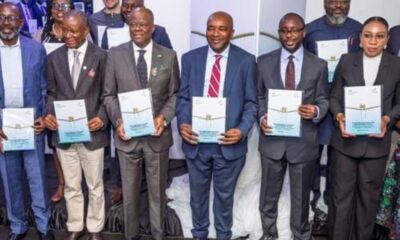
NESG appoints Engr. Adeleye Falade, FNSE to its board
-
 Economy1 hour ago
EBID, CORIS Holding sign 80m euro financing agreement to strengthen food, energy, agric value chains in West Africa