
Economy
Director General BPE, Alex Okoh test negative of COVID19, speaks from self isolation

By Alex Okoh
I greet you warmly in the hope and prayer that you are safe and well in the face of the Covid 19 pandemic. Indeed, the challenge and scale of this strange and sudden infestation, Coronavirus has left the world in a combination of fear, confusion and indignation. The responses have also been a combination of tentative, measured and unmeasured initiatives as the world throws all it knows at a problem that we know so little about. Indeed, it is becoming quite clear that the notion that certain regions will be spared the scourge of this deadly pestilence is an abject fallacy. The world is a mobile village, and in a vibrant and dynamic village, the velocity of interactions suggest that experiences are easily and rapidly projected and transferred across the community albeit a global one. We are beginning to find out that the matter is closer than we think or would wish.
So, having recently arrived from two “high risk” and “hot spot l” locations in Europe, I decided to self-isolate last week and observe the mandatory 14 days distancing period. However, two days ago, Tuesday March 24, with the growing number of identified cases in Nigeria, I decided to take the test. The team of the NCDC health workers who conducted the test were extremely professional and I would like to use this opportunity to salute our health workers and officials who are daring the odds and taking significant risks to keep us safe and well. Of course, my sweetheart tops the list. They are doing an incredibly job despite the challenges. God bless you all. The waiting period for the test was quite a testy one. Perhaps one of the most difficult 24 hour period anyone can imagine. Various scenarios were playing out. Those who I had been in contact with kept calling for my result and their panic almost made me develop “psychological” symptoms. Lol! In fact a colleague of mine who took the result at the time I did called to inform me that he woke up yesterday morning with a headache. I told him that it was a “psychological” symptom and nothing that a solid breakfast wouldn’t cure. He took more than my advise and seized the opportunity to indulge in his favourite pastime. A good meal.
The result finally came out last night, and it was NEGATIVE for me, my colleague and our spouses. Glory be to God. However, I learnt a lot from the experience of the past few days, and this has affected my perspective of what we are dealing with in the sense of this pandemic, and how we need to rise as one humanity to ensure that we do our best to defeat this global enemy. The first lesson I learnt is that this situation does not call for gloom nor glee. The virus is not contracted by indulging in an irresponsible lifestyle (if you take deliberate unhygienic behaviours out of that definition), such as is sometimes the case with other communicable diseases such as AIDS.
So there is no need to glee over or stigmatise anyone. Most rational people do not go courting illness. No one deliberately goes looking for Malaria, Cancer or Coronavirus. Sicknesses generally do not discriminate according to social or economic status or position as we are beginning to better appreciate. Incidentally, the Bureau of Public Enterprises, the agency of Government that I work for has been developing a framework to reform our healthcare sector and the fundamental principle of the reform program is guided by the notion I have alluded to above, that in most cases, sicknesses occur outside the will of the individual victim. No sane person goes courting illness. As such a primary goal and responsibility of government, next to preserving the lives of the citizens is to preserve those lives in good health. This is done through the provision of universal access to a decent and comprehensive healthcare delivery system at little or no cost to the citizen. This is however is a topic for another day, suffice to say for now that I hope the reform program will receive the endorsement of all the stakeholders when the program debuts.
The second lesson, I have learnt from with regards to the Covid 19 pandemic is that the situation we face can easily become incurably overwhelming, if we allow ourselves to be frozen into confusion or worse still, inaction. The question usually asked is “what can I do” or “what is the government doing”?My sense is that we have no time for the luxury of such inquiries. We need to get up and do something and as someone starts, others will follow. We cannot pretend that we know all the issues or have all the information we need to be guided into precise decisions with predictable outcomes, but we need to act in line with what we know and we refine and adapt as we execute. But we certainly can not afford to do nothing. That will be catastrophic and will put the well being of the people at serious jeopardy.
I am glad to note that already, the famed Nigerian spirit of ingenuity and indomitability is beginning to show up. A wonderful lady who I know quite closely has started to crowdfund, albeit on a small scale, a process through which monies are made available to some of the most vulnerable in our society whose normal sources of income are through daily enterprise, which are being affected by the necessary “stay-at-home order”. That is action. That is an example of what can be done.
Another friend of mine, of course much wealthier than this lady, has shared with me a plan to convert the “This Day Dome” in Abuja into a 500 bed facility. That is action. That is an example of what can be done. #I will do something. We have all got to be thinking of what we can do in the event that this pandemic egregiously fractures the supply chain of the physical essentials of life and living. Food. Water. Medicine. Electricity. It is my hope that the providers of some of our utilities will show good faith and sensitivity in this situation, by not cutting supply of electricity and telecommunications services. I hope our hospitals also extend humane gestures at this time to critical cases who may be financially constrained. #I will do something.
On my part, I am mobilising both officially and privately to enable a support structure of a supply chain to ensure that basic requirements are delivered to some of the vulnerable groups in my locality, should the situation escalate to such a level. I refuse to sit and do nothing. # I will do something. All said, this is a crisis that requires the resolve of all Nigerians acting in concert. It is not a time for political posturing or blame gaming. We rise to beat this thing together or we will experience such a defeat that leaves no one unscathed no matter how remotely. My responsibility as a citizen demands that I comply with the directives of government. My responsibility as a public officer demands that I take initiatives to provide some solution. However, I have an even bigger responsibility; that of an ordained Pastor, and this sacred responsibility demands that, I pray for the healing of my nation.
2 Chronicles 7:14 (NKJV)
14 if My people who are called by My name will humble themselves, and pray and seek My face, and turn from their wicked ways, then I will hear from heaven, and will forgive their sin and heal their land. May God have mercy and deliver us from this deadly pestilence.
Be safe. Be blessed.
*Alex Okoh is the Director General BPE
-
 Economy2 hours ago
CPPE expresses worry over real-sector financing gap of over ₦50trn, proposes new devt-finance architecture
-
 Oil and Gas2 hours ago
Energy professionals demand probe of NNPC, NUPRC over transparency concerns
-
 Economy2 hours ago
Alake’s media aide debunks claims of handing over Nigeria’s solid minerals to Chinese
-
 Oil and Gas2 hours ago
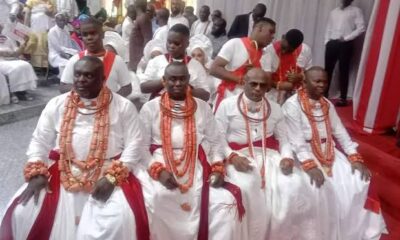
Group urges Ogoni to support resumption of oil production, 33-year shutdown cost Nigeria, Rivers $226bn
-
 Industry1 hour ago
Dangote, Sinoma Sign $800 Million MOU to Expand Itori Cement Plant Capacity to 12 MTA