News
FG rejects US troops, says Trump’s narrative fueling more violence, seeks stronger U.S. partnership to defeat terrorism
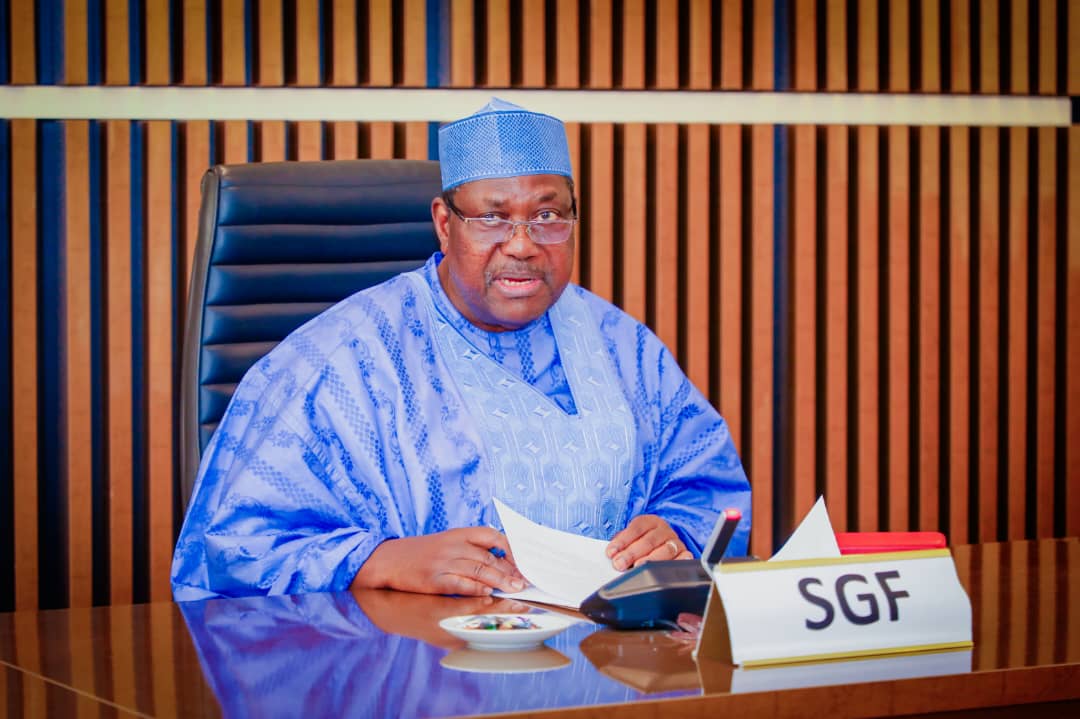
The Federal Government on Wednesday vehemently pushed back against what it called the “dangerous and inaccurate” Christian genocide narrative spearheaded by United States President, Donald Trump, saying Nigeria does not need foreign troops on its soil, but targeted support from its partners and allies. ”The Nigerian Armed Forces are highly capable, experienced and professional. Nigeria does not require foreign troops”, said the federal government. It warned that such claims are already emboldening opportunistic violent groups and aggravating insecurity across parts of the country. This position was contained in a detailed statement issued on Wednesday in Abuja and signed by the Secretary to the Government of the Federation, Senator George Akume.
According to the federal government, “no credible international organization has ever classified Nigeria’s security crisis as a genocide against Christians or any group.” Akume said the President Bola Tinubu administration considers the proliferation of the genocide narrative not only false but “deeply harmful to national security,” stressing that it is now “fueling more violence, sharpening sectarian suspicion, and giving opportunistic extremist actors a propaganda lifeline they had long lost.”
According to him, Nigeria’s complex security challenge has evolved across two separate fronts over the past two decades – the ideological insurgency of Boko Haram and ISWAP in the North-East, and the economically driven banditry ravaging the North-West. “Across Nigeria, Christians and Muslims have been equally victimised. Boko Haram and ISWAP attack both churches and mosques, killing Muslims and Christians alike. Bandits target communities without any religious distinction”, he declared. The SGF emphasized that while Boko Haram originated as a radical ideological sect that later drew influence from Al-Qaeda and ISIS,
North-West banditry is “overwhelmingly economic deterministic,” rooted in illegal mining, cattle rustling, kidnapping-for-ransom and control of natural resources. “These pressures, not religion, explain the persistence of violence in the North-West,” he said. Akume also offered a historical account of how weapons proliferation from the collapse of Libya in 2011 and instability in Egypt strengthened terrorist networks across the Sahel, feeding both Boko Haram and ISWAP. “Weapons flowing through AQIM-controlled smuggling routes entered West Africa and Nigeria, strengthening Boko Haram, ISWAP and later banditry networks,” he noted. On claims being circulated internationally that Christians are being systematically exterminated, the federal government rejected such framing. “Nigeria rejects any characterization of the conflict as a genocide against Christians or any group. Verified evidence shows that insurgents and criminal networks attack both churches and mosques, killing Muslims and Christians alike”, said Akume. He warned that the amplification of false narratives abroad, particularly in the United States, has had real consequences on the ground.

“Recent pronouncements from the United States have inadvertently emboldened opportunistic violent groups seeking to exploit international narratives and make bold statements by attacking soft targets. Before these statements, insurgency structures had been significantly degraded and reduced to isolated banditry”, he said. The SGF underscored the capability of Nigeria’s military, saying; “The Nigerian Armed Forces are highly capable, experienced and professional. Nigeria does not require foreign troops. What is needed is targeted support from partners, especially the United States, in intelligence cooperation, technology and military equipment.”
The government also referenced recent mass casualty attacks, including the June 2025 killings in Yelewata, Benue State, where at least 100 people were murdered. Akume noted that the President immediately dispatched him to the affected communities with relief materials, after which the President personally visited survivors in the hospital. “The President directed a complete census of destruction and approved funds for reconstruction of the affected areas,” he said. Reaffirming Nigeria’s secular character, Akume stated; “Nigeria is a secular state as guaranteed by the constitution. No state religion is adopted as a national religion and no citizen is above the constitution. Appointments made by the administration reflect the diversities of our nation, with both Christians and Muslims holding key positions, including in the Nigerian Security Council.” He stressed that Nigeria desires deeper cooperation, not public mischaracterization, from its allies.
“As the United States remains the largest democracy in the world, and Nigeria, the largest democracy in Africa, modeled after the American system, our two nations share a historic responsibility to work together to promote global stability, strengthen democratic values especially in Africa, and confront extremist threats in Nigeria and other neighboring nations”, he said. The federal government also appealed for unity among Nigerians, saying; “I wish to appeal to the sense of patriotism of all Nigerians irrespective of tribe, religion or political persuasion. Now is the time to speak with one strong and united voice to confront a common enemy – terrorists, bandits and extremist insurgents – and completely eradicate them from our national borders.”
News
Nigeria–China tech deal to boost jobs, skills, local opportunities
A new technology transfer agreement between the Nigeria–China Strategic Partnership (NCSP) and the Presidential Implementation Committee on Technology Transfer (PICTT) is expected to open more job opportunities, improve local skills, and expand access to advanced technology for ordinary Nigerians.
In a press statement reaching Vanguard on Friday, the MoU aims to strengthen industrial development, support local content, and create clearer pathways for Nigerians to benefit from China’s growing investments in the country.
PICTT Chairman, Dr Dahiru Mohammed, said the partnership will immediately begin coordinated programmes that support local participation in infrastructure and industrial projects.
Special Adviser to the President on Industry, Trade and Investment, Mr John Uwajumogu, said the deal will help attract high value investments that can stimulate job creation and strengthen Nigeria’s economy.
NCSP Head of International Relations, Ms Judy Melifonwu, highlighted that Nigerians stand to gain from expanded STEM scholarships, technical training, access to modern technology, and collaboration across key sectors including steel, agriculture, automobile parks, and cultural industries.
The NCSP Director-General reaffirmed the organisation’s commitment to measurable results, noting that the partnership with PICTT will prioritise initiatives that deliver direct national impact.
The MoU signals a new phase of Nigeria–China cooperation focused on practical delivery, local content, and opportunities that improve everyday livelihoods.
News
EU hits Meta with antitrust probe over plans to block AI rivals from WhatsApp
EU regulators launched an antitrust investigation into Meta Platforms on Thursday over its rollout of artificial intelligence features in its WhatsApp messenger that would block rivals, hardening Europe’s already tough stance on Big Tech. The move, reported earlier by Reuters and the Financial Times, is the latest action by European Union regulators against large technology firms such as Amazon and Alphabet’s Google as the bloc seeks to balance support for the sector with efforts to curb its expanding influence.
Europe’s tough stance – a marked contrast to more lenient U.S. regulation – has sparked an industry pushback, particularly by U.S. tech titans, and led to criticism from the administration of U. S. President Donald Trump. The European Commission said that the investigation will look into Meta’s new policy that would limit other AI providers’ access to WhatsApp, a potential boost for its own Meta AI system integrated into the platform earlier this year.
EU antitrust chief Teresa Ribera said the move was to prevent dominant firms from “abusing their power to crowd out innovative competitors”. She added interim measures could be imposed to block Meta’s new WhatsApp AI policy rollout. “AI markets are booming in Europe and beyond,” she said. This is why we are investigating if Meta’s new policy might be illegal under competition rules, and whether we should act quickly to prevent any possible irreparable harm to competition in the AI space.”
A WhatsApp spokesperson called the claims “baseless”, adding that the emergence of chatbots on its platforms had put a “strain on our systems that they were not designed to support”, a reference to AI systems from other providers. “Still, the AI space is highly competitive and people have access to the services of their choice in any number of ways, including app stores, search engines, email services, partnership integrations, and operating systems.” The EU was the first in the world to establish a comprehensive legal framework for AI, setting out guardrails for AI systems and rules for certain high-risk applications in the AI Act.
Meta AI, a chatbot and virtual assistant, has been built into WhatsApp’s interface across European markets since March. The Commission said a new policy fully applicable from January 15, 2026, may block competing AI providers from reaching customers via the platform. Ribera said the probe came on the back of complaints from small AI developers about the WhatsApp policy. The Interaction Company of California, which has developed AI assistant Poke.com, has taken its grievance to the EU competition enforcer. Spanish AI startup Luzia has also talked to the Commission, a person with knowledge of the matter said.
Marvin von Hagen, co-founder and CEO of The Interaction Company of California, said if Meta was allowed to roll out its new policy, “millions of European consumers will be deprived of the possibility of enjoying new and innovative AI assistants”. Meta also risks a fine of as much as 10% of its global annual turnover if found guilty of breaching EU antitrust rules.
Italy’s antitrust watchdog opened a parallel investigation in July into allegations that Meta leveraged its market power by integrating an AI tool into WhatsApp, expanding the probe in November to examine whether Meta further abused its dominance by blocking rival AI chatbots from the messaging platform. The antitrust probe is a more traditional means of investigation than the EU’s Digital Markets Act, the bloc’s landmark legislation currently used to scrutinize Amazon’s and Microsoft’s cloud services for potential curbs. Reuters
News
Billionaires are inheriting record levels of wealth, UBS report finds
The spouses and children of billionaires inherited more wealth in 2025 than in any previous year since reporting began in 2015, according to UBS’s Billionaire Ambitions Report published on Thursday. In the 12 months to April, 91 people became billionaires through inheritance, collectively receiving $298 billion, up more than a third from 2024, the Swiss bank said. “These heirs are proof of a multi-year wealth transfer that’s intensifying,” UBS executive Benjamin Cavalli said.
The report is based on a survey of some of UBS’s super-rich clients and a database that tracks the wealth of billionaires across 47 markets in all world regions. At least $5.9 trillion will be inherited by billionaire children over the next 15 years, the bank calculates.
Most of this inheritance growth is set to take place in the United States, with India, France, Germany and Switzerland next on the list, UBS estimated. However, billionaires are highly mobile, especially younger ones, which could change that picture, it added. The search for a better quality of life, geopolitical concerns and tax considerations are driving decisions to relocate, according to the report.
In Switzerland, where $206 billion will be inherited over the next 15 years according to the bank, voters on Sunday overwhelmingly rejected 50 per cent tax on inherited fortunes of $62 million or more, after critics said it could trigger an exodus of wealthy people.
Switzerland, the UAE, the U.S. and Singapore are among billionaires’ preferred destinations, UBS’s Cavalli said. “In Switzerland, Sunday’s vote may have helped to increase the country’s appeal again,” he said. Reuters
-
News3 days agoNigeria to officially tag Kidnapping as Act of Terrorism as bill passes 2nd reading in Senate
-
News3 days agoNigeria champions African-Arab trade to boost agribusiness, industrial growth
-
News3 days agoFG’s plan to tax digital currencies may push traders to into underground financing—stakeholders
-
Finance1 week agoAfreximbank successfully closed its second Samurai Bond transactions, raising JPY 81.8bn or $527m
-
News1 week agoFG launches fresh offensive against Trans-border crimes, irregular migration, ECOWAS biometric identity Card
-
Economy3 days agoMAN cries out some operators at FTZs abusing system to detriment of local manufacturers
-
News3 days agoEU to support Nigeria’s war against insecurity
-
Uncategorized3 days agoDeveloping Countries’ Debt Outflows Hit 50-Year High During 2022-2024—WBG