
Economy
Nigeria’s inflation rate inches up to 15.93% in May, CPPE attributes rise to impact of geopolitical tensions in the Middle East

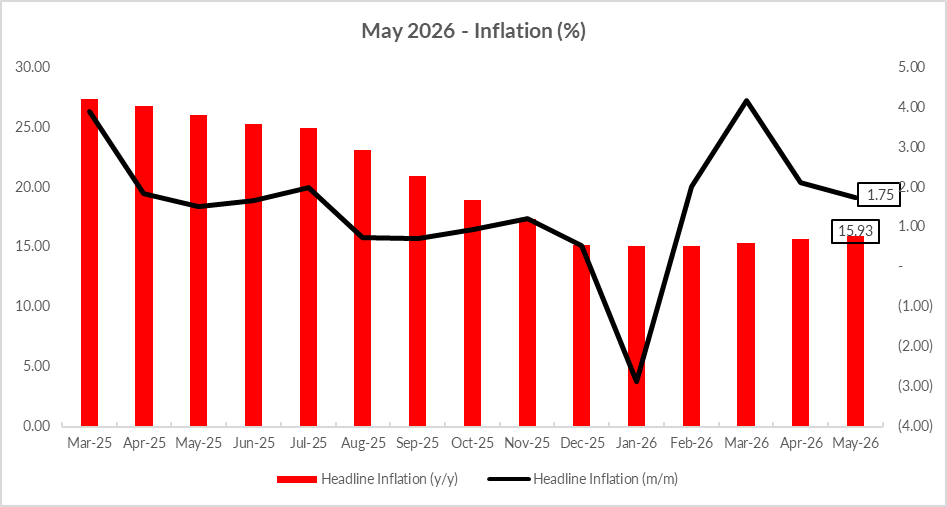
Nigeria’s headline inflation rate rose to 15.93% in May from 15.69% in April 2026 as reported by National Bureau of Statistics in its latest report of its consumer price index (CPI) for the month of May.
But Centre for the Promotion of Private Enterprise (CPPE) notes the marginal increase 0.24% in headline inflation from 15.69% in April 2026 to 15.93% in May 2026, reflecting the continuing impact of recent geopolitical tensions in the Middle East on global energy markets and supply chains.
This upswing is the third consecutive rise in the inflation rate in the year giving policy makers in the country some concern. National Bureau of Statistics (NBS) released the report on Monday.
In the report NBS said the headline inflation rose on a year-on-year basis to 15.93% in May, up from 15.69% in April 2026 and down from 26.06% in the same month of the preceding year (May 2025).
However, CPPE said “The surge in crude oil prices, elevated marine insurance costs, disruptions to shipping routes and higher import costs have all combined to exert upward pressure on domestic prices.
“However, beneath the year-on-year increase lies a more encouraging trend. Headline inflation moderated on a month-on-month basis from 2.13% in April to 1.75% in May, while food inflation eased from 3.63% to 2.98%.
“This suggests that although inflationary pressures persist, the pace of price escalation is slowing. It is also noteworthy that the current inflation rate remains significantly below the 26.06% recorded in May 2025, underscoring the substantial disinflation achieved over the past year.
“The major drivers of inflation remain food and beverages, transportation, housing, energy, health and education, which collectively account for about 87% of headline inflation.
“This highlights the reality that the inflation burden is concentrated in the basic necessities consumed by ordinary Nigerians.
“Food inflation at 16.96% remains particularly concerning, as it continues to outpace headline inflation and weaken household purchasing power.
“A major structural factor behind elevated food prices is the persistent insecurity in key food-producing regions. Insecurity has displaced farming communities, reduced cultivated acreage, disrupted agricultural supply chains and increased transportation costs.
“The consequence is lower agricultural output and tighter food supply, which continue to fuel food inflation. Therefore, tackling insecurity is not only a security imperative; it is also a critical inflation-management strategy.
“The inflation challenge remains largely cost-push in nature. Accordingly, the solution lies less in monetary tightening and more in addressing the structural drivers of production and distribution costs.

“Government intervention should focus on improving food security, strengthening logistics infrastructure, investing in mass transit and rail transportation, enhancing energy security and restoring safety in farming communities.
“The recent diplomatic breakthrough in the Middle East and the moderation of crude oil prices from about $90 per barrel to approximately $83 per barrel provide grounds for cautious optimism.
“If geopolitical tensions continue to ease and supply chain conditions improve, inflationary pressures could begin to moderate from the third quarter of 2026.
“According to NBS “For now, the inflation uptick appears to be more of an external shock phenomenon and domestic structural headwinds than a reflection of domestic macroeconomic instability.
The policy priority should therefore be to tackle the structural cost drivers of inflation, particularly insecurity, food supply constraints, transportation costs and energy prices. These are the pressure points that matter most to citizens’ welfare and business competitiveness.
May 2026 Headline inflation rate showed an increase of 0.24% compared to the April 2026 Headline inflation rate.
“In May 2026, the headline inflation rate on a month-on-month basis was 1.75%, which was 0.39% lower than the rate recorded in April 2026 (2.13%).
“This means that in May 2026, the rate of increase in the average price level was lower than the rate of increase in the average price level in April 2026.”
The index also indicated that food inflation rose to 16.96 percent in May from 16.68 percent in April.
“The food inflation rate in May 2026 on a month-on-month basis was 2.98%, down by 0.65% points from April 2026 (3.63%)” the report said.
“This can be attributed to the rate of change in the average prices of the following products: Onions (fresh), Maize (Corn) grains, Melon (Egusi), Water Yam, Cassava Flour, Crayfish, Pepper (fresh), Tomatoes (fresh), Wheat Grain, Cassava Tuber, Yam Tuber, Sweet Potatoes, Ginger (fresh), Plantain, Cow Pea, etc,” the report said.
-
 Economy11 minutes ago
Global Economy Endures War Shock So Far–Georgieva
-

 News16 minutes ago
Afreximbank cancels annual meeting on Ebola concerns
-
 Agriculture14 minutes ago
AFC backs $7bn Dangote Fertiliser expansion to strengthen Africa’s food security
-

 Economy7 minutes ago
Manufacturing sector paid N329.59bn to FG as VAT; company income tax net N1.37trn in Q1 2026—NBS
-

 News5 minutes ago
FG, States, LGs shared N2.26trn as April FAAC allocation