
Agriculture
African Development Bank approves $11.7m to facilitate access to fertilisers for African farmers

The Board of Directors of the African Development Bank has approved a $11.7 million budgetary allocation to the African Fertiliser Financing Mechanism for its 2023 operations.The approval adds up to $16.4 million extended to the Facility to support its 2023 budget. It includes $4.7 million, which was carried over from the previous year. The Board of Directors also validated AFFM’s 2023 program of activities: strengthening the fertiliser sector through access to finance, supporting the development of sustainable policy reforms to improve fertiliser production, trade and use, and facilitating access to inputs and technical assistance for smallholder farmers.
AFFM plans to continue implementing three commercial credit guarantee projects amounting to $8.3 million. The recipient countries are Zimbabwe ($4.3 million), Côte d’Ivoire ($2 million), and Ghana ($2 million). For 2023, it plans to implement trade credit guarantee schemes totaling $9.7 million in Tanzania, Uganda, Mozambique and Kenya. Three more new projects could be launched in Senegal, Zambia and Ghana if the United States Agency for International Development (USAID) follows through on its $15 million commitment to the AFFM. The 2023 projects will be implemented to support the second pillar of the Bank’s African Emergency Food Production Facility, which was launched to avert a looming food crisis in Africa following Russia’s invasion of Ukraine. In addition, AFFM will actively work with African countries and other key stakeholders to develop the national food and agriculture pacts that the continent’s leaders presented at the Feed African Summit in Dakar in January 2023.
The AFFM will facilitate smallholder farmers’ access to inputs and extension services through credit guarantee projects and capacity building for farmers and input distributors. Objectives: to ensure proper use of fertilisers, increase agricultural productivity and improve soil conditions. AFFM will continue to work with the International Fertiliser Development Centre (IFDC) and the Alliance for a Green Revolution in Africa (AGRA) on initiatives to improve fertiliser production, trade and use launched in 2021. It will also conduct an in-depth analysis of fertiliser policy in at least ten African countries, which will map the current situation, identify gaps and prepare an action plan. The aim is to support policy orientations that will address the identified shortcomings.

Established by the African Union in Abuja in 2006, the African Fertiliser Financing Mechanism is a special fund that aims to improve agricultural productivity by providing the necessary financing to boost fertiliser use in Africa and achieve the 50 kilograms of nutrients per hectare target. It is hosted and managed by the African Development Bank. AFFM has a strategic plan for 2022-2028 period. In Africa, AFFM’s work is crucial in addressing food crises and various threats to food security caused by Russia’s war in Ukraine, climate change (drought, floods, soil depletion, etc.), conflict, locust infestation and disease.
-

 Economy2 days ago
Manufacturers still face high production costs despite lower inflation—MAN
-
News2 days ago
NDLEA intercepts 1.3m tramadol pills, 6,000kg cannabis worth N3.4bn nabs fake police officer
-

 Uncategorized2 days ago
Red Star Express posts stronger profit growth as revenue rises to N23.5bn
-

 Finance18 hours ago
Financial expert predicts 50 basis points reduction in MPR
-

 Economy18 hours ago
Nigeria DRE Fund reaches commercial milestone
-

 News18 hours ago
Afreximbank, ATDC sign $500m facility to expand African trade and distribution
-
 Economy2 days ago
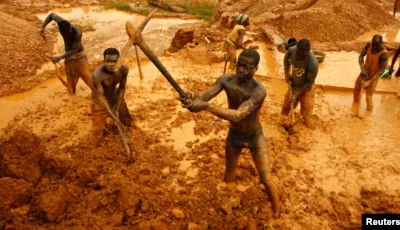
350 Niger’s hidden child miners rescued, thousands more at risk—CSO warns
-

 Economy2 days ago
Retail trade in Nigeria faces stiff foreign competition—CPPE