Connect with us

News

As Nigeria scraps fuel subsidy, a vibrant black market collapses

Published

on

Things have been topsy turvy lately on the roadsides of West African nations where cheap contraband petrol from Nigeria has abruptly doubled in price, upending an informal sector that is central to the region’s economic activity. Since Nigeria scrapped a state fuel subsidy on May 31, black market fuel vendors and commercial drivers in Cameroon, Benin and Togo who were heavily reliant on petrol smuggled from Nigeria have seen their businesses collapse. With supplies dwindling, queues have been forming at official petrol stations, where fuel is now competitively priced.

In Garoua, a town in northwest Cameroon about 60 km (37 miles) east of the Nigerian border, a litre of petrol on the black market used to sell for about 300 CFA francs ($0.48). Now the minimum is 600 CFA francs, vendors said. “Supply has become scarce and customers think we’re ripping them off with this high price, yet it’s from Nigeria that prices have soared,” said Perevet Dieudonne, a black market seller. The knock-on effects on motorcycle-taxis, a form of public transport ubiquitous in West Africa, include conflict between riders who often live hand-to-mouth and customers who demand cheap fares no matter what. Ousmanou Mal Djoulde, a rider in Garoua, said he had been forced to more than double his fares. Many customers were refusing to pay and business was agonisingly slow.

The trade in black market fuel is so central to the local economy that authorities either turn a blind eye or are complicit. A Reuters reporter in Garoua saw a Cameroonian customs officer sitting on a motorcycle-taxi that was being refuelled with smuggled Nigerian petrol. There is no reliable data on the amount of fuel that is smuggled from Nigeria. The head of Nigeria’s state-controlled oil firm NNPC, the sole supplier, said early this month 66 million litres of petrol left its depots daily but could not say how much was consumed locally, though he admitted smuggling was rampant. Independent energy experts and Nigeria’s Dangote Petroleum Refinery – which expects to start producing petrol from early August to alleviate chronic fuel shortages – put Nigeria’s total daily consumption below 40 million litres. In Benin and Togo, small nations to the west of Nigeria, contraband fuel vendors have lost both supplies and customers while formerly sleepy official petrol stations are suddenly busy. At Hilacondji, a border crossing between Togo and Benin, some black market fuel stalls were shut, while at others vendors waited among rows of empty plastic jerrycans for potential deliveries.

“While we wait for the situation to improve, some have gone into fishing or other small businesses,” said Ayi Hilla, who had been making a living from selling contraband fuel for 10 years but was now focusing on running a small roadside bar. Some informal fuel depots were being demolished, and men who used to work there unloading and carrying petrol were now unemployed. More than 80% of employment in Africa is informal, according to the United Nations, making the informal sector a key driver of economic activity. In Cotonou, the commercial capital of Benin which is about 60 km from Nigeria, queues have been building up at official petrol stations and some have been unable to meet the sudden surge in demand, especially from “zemidjan”, the local word for motorcycle-taxis. “Before, we were selling about 2,000 litres per day, but now we’re selling up to 7,000 litres per day,” said a worker at the JNP fuel station who gave his first name, Janvier. He had just turned away four customers because supplies had run out. “The zemidjan-men are even fighting to get served,” said Janvier.

Continue Reading

News

Nigeria–China tech deal to boost jobs, skills, local opportunities

Published

on

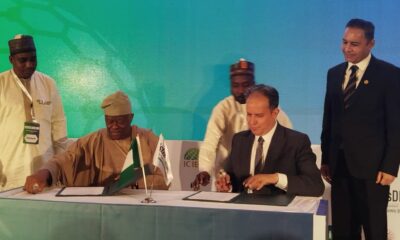
A new technology transfer agreement between the Nigeria–China Strategic Partnership (NCSP) and the Presidential Implementation Committee on Technology Transfer (PICTT) is expected to open more job opportunities, improve local skills, and expand access to advanced technology for ordinary Nigerians. 

In a press statement reaching Vanguard on Friday, the MoU aims to strengthen industrial development, support local content, and create clearer pathways for Nigerians to benefit from China’s growing investments in the country.

PICTT Chairman, Dr Dahiru Mohammed, said the partnership will immediately begin coordinated programmes that support local participation in infrastructure and industrial projects.

Special Adviser to the President on Industry, Trade and Investment, Mr John Uwajumogu, said the deal will help attract high value investments that can stimulate job creation and strengthen Nigeria’s economy.

NCSP Head of International Relations, Ms Judy Melifonwu, highlighted that Nigerians stand to gain from expanded STEM scholarships, technical training, access to modern technology, and collaboration across key sectors including steel, agriculture, automobile parks, and cultural industries.

The NCSP Director-General reaffirmed the organisation’s commitment to measurable results, noting that the partnership with PICTT will prioritise initiatives that deliver direct national impact.

The MoU signals a new phase of Nigeria–China cooperation focused on practical delivery, local content, and opportunities that improve everyday livelihoods.

Continue Reading

News

EU hits Meta with antitrust probe over plans to block AI rivals from WhatsApp

Published

on

EU regulators launched an antitrust investigation into Meta Platforms on Thursday over its rollout of artificial intelligence features in its WhatsApp messenger that would block rivals, hardening Europe’s already tough stance on Big Tech. The move, reported earlier by Reuters and the Financial Times, is the latest action by European Union regulators against large technology firms such as Amazon and Alphabet’s Google as the bloc seeks to balance support for the sector with efforts to curb its expanding influence.

Europe’s tough stance – a marked contrast to more lenient U.S. regulation – has sparked an industry pushback, particularly by U.S. tech titans, and led to criticism from the administration of U. S. President Donald Trump. The European Commission said that the investigation will look into Meta’s new policy that would limit other AI providers’ access to WhatsApp, a potential boost for its own Meta AI system integrated into the platform earlier this year.

EU antitrust chief Teresa Ribera said the move was to prevent dominant firms from “abusing their power to crowd out innovative competitors”. She added interim measures could be imposed to block Meta’s new WhatsApp AI policy rollout. “AI markets are booming in Europe and beyond,” she said. This is why we are investigating if Meta’s new policy might be illegal under competition rules, and whether we should act quickly to prevent any possible irreparable harm to competition in the AI space.”

A WhatsApp spokesperson called the claims “baseless”, adding that the emergence of chatbots on its platforms had put a “strain on our systems that they were not designed to support”, a reference to AI systems from other providers. “Still, the AI space is highly competitive and people have access to the services of their choice in any number of ways, including app stores, search engines, email services, partnership integrations, and operating systems.” The EU was the first in the world to establish a comprehensive legal framework for AI, setting out guardrails for AI systems and rules for certain high-risk applications in the AI Act.

Meta AI, a chatbot and virtual assistant, has been built into WhatsApp’s interface across European markets since March. The Commission said a new policy fully applicable from January 15, 2026, may block competing AI providers from reaching customers via the platform. Ribera said the probe came on the back of complaints from small AI developers about the WhatsApp policy. The Interaction Company of California, which has developed AI assistant Poke.com, has taken its grievance to the EU competition enforcer. Spanish AI startup Luzia has also talked to the Commission, a person with knowledge of the matter said.

Marvin von Hagen, co-founder and CEO of The Interaction Company of California, said if Meta was allowed to roll out its new policy, “millions of European consumers will be deprived of the possibility of enjoying new and innovative AI assistants”. Meta also risks a fine of as much as 10% of its global annual turnover if found guilty of breaching EU antitrust rules.

Italy’s antitrust watchdog opened a parallel investigation in July into allegations that Meta leveraged its market power by integrating an AI tool into WhatsApp, expanding the probe in November to examine whether Meta further abused its dominance by blocking rival AI chatbots from the messaging platform. The antitrust probe is a more traditional means of investigation than the EU’s Digital Markets Act, the bloc’s landmark legislation currently used to scrutinize Amazon’s and Microsoft’s cloud services for potential curbs. Reuters

Continue Reading

News

Billionaires are inheriting record levels of wealth, UBS report finds

Published

on

The spouses and children of billionaires inherited more wealth in 2025 than in any previous year since reporting began in 2015, according to UBS’s Billionaire Ambitions Report published on Thursday. In the 12 months to April, 91 people became billionaires through inheritance, collectively receiving $298 billion, up more than a third from 2024, the Swiss bank said. “These heirs are proof of a multi-year wealth transfer that’s intensifying,” UBS executive Benjamin Cavalli said.

The report is based on a survey of some of UBS’s super-rich clients and a database that tracks the wealth of billionaires across 47 markets in all world regions. At least $5.9 trillion will be inherited by billionaire children over the next 15 years, the bank calculates.
Most of this inheritance growth is set to take place in the United States, with India, France, Germany and Switzerland next on the list, UBS estimated. However, billionaires are highly mobile, especially younger ones, which could change that picture, it added. The search for a better quality of life, geopolitical concerns and tax considerations are driving decisions to relocate, according to the report.

In Switzerland, where $206 billion will be inherited over the next 15 years according to the bank, voters on Sunday overwhelmingly rejected 50 per cent tax on inherited fortunes of $62 million or more, after critics said it could trigger an exodus of wealthy people.
Switzerland, the UAE, the U.S. and Singapore are among billionaires’ preferred destinations, UBS’s Cavalli said. “In Switzerland, Sunday’s vote may have helped to increase the country’s appeal again,” he said. Reuters

Continue Reading

Trending