
Finance
Banks hoarded redesigned naira, EFCC witness tells court in ex-CBN governor Emefiele’s trial

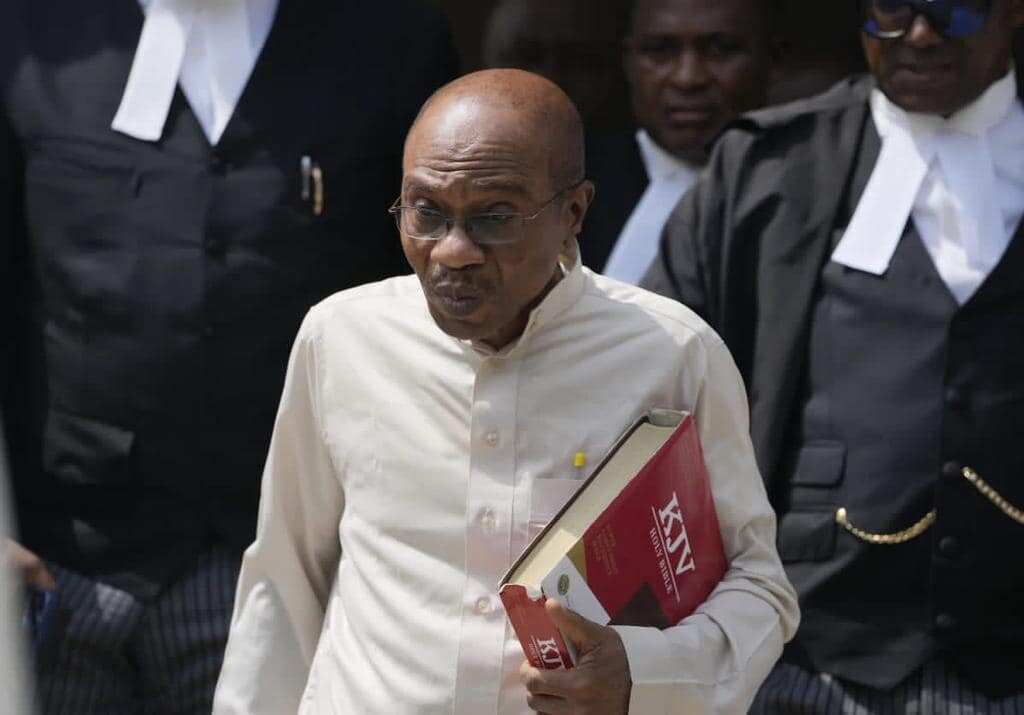
An Economic and Financial Crimes Commission (EFCC) witness on Tuesday told a Federal High Court, Abuja Division, that commercial banks hoarded currencies during the controversial naira redesign, which led to untold hardship for many Nigerians.
The witness Chinedu Eneanya, is the seventh prosecution witness (PW7) in the trial of a former governor of the Central Bank of Nigeria, Godwin Emefiele, for the disobedience to presidential directive in the naira redesign.
The EFCC alleged that Mr Emefiele, among others, between October 19, 2022 and March 5, 2023, disobeyed the direction of Section 19 of CBN Act by approving the printing of 375,520,000 pieces of colour swapped N1,000 notes at a total cost of N11,052,068,062 without the recommendation of the CBN Board and strict approval of the President, Federal Republic of Nigeria, which caused injury to the public.
The offence, the anti-graft agency said contravened the provisions of Section 123 of the Penal Code, Cap 89 Laws of the Federation, 1990 and punishable under the same law.
He, however, pleaded not guilty to the charge. The witness , an investigator with EFCC however, said he could not recall the total number of banks where officials hoarded currencies. The witness said this while being cross-examined by Mr Emefiele’s counsel Olalekan Ojo, SAN.
When asked “can you confirm to the honourable court that bank officials were hoarding mints?” He replied, “I am aware of that, but I cannot be specific.” Mr Eneanya also could not recall the banks where the infractions were uncovered.
The witness was asked if the EFCC arrested bank officials responsible for hoarding the currencies. The EFCC counsel, A.O Mohammed, objected to the question, noting that the witness’s beat was limited to investigations.
He stated, “His beat was specific; whether it (naira redesign) was a valid approval.”
However, Mr Ojo argued that the witness was not limited to his evidence in chief and, as an investigative officer, had the power to make an arrest.
He noted that the question was also necessary since EFCC alleged that Mr Emefiele caused undue hardship to Nigerians due to the shortage of the redesigned currencies.
Justice Maryann Anenih after confirming the witness’s designation, asked Mr Eneanya to answer the question. He replied, “I stated before this court that the EFCC raised a task force; I didn’t say it was my team.”
The witness said he was not aware of what the EFCC did to the bank officials that caused the infractions.
When asked on whose instructions the EFCC embarked on the visit to the commercial banks, the witness said he was “not privy to that information.”
Mr Ojo then asked the prosecution to furnish the defence with the documents related to the case and asked for an adjournment.
Justice Anenih subsequently , adjourned the matter until March 19 for the continuation of the cross-examination of the witness. Earlier during the day’s proceeding, the witness stated that the Managing Director (MD) of Nigerian Security Printing and Minting Plc (NSPM), Ahmed Halilu, disclosed the email communication between De La Rue and himself to the EFCC team.
He said, “The email was made available to my team by the MD of NMPS, and subsequently, the email was opened in front of the team.” He admitted that Halilu had written a series of statements but could not recall them all.
This prompted Mr Ojo to request the statements. When asked if the NSPM had ever designed naira notes at any point in time, he said he “could not remember.” The witness also could not recall the quantity of currencies available to commercial banks.
He requested that he be allowed to check the records to refresh his memory. When questioned if the EFCC team reached out to the commercial banks to confirm the specific amounts given to them, he said,
“We have a team that went nationwide in conjunction with other law enforcement agencies, taking stock and ensuring that those currencies were made available in public.”
He also said that the team kept a record of the stock taken exercise in regards to what was made available to commercial banks. Mr Ojo further asked for the records to be produced to the defence. When asked if bank vaults were also checked by the EFCC, the witness said he “was not there in all the teams”
At the beginning of the proceedings, Mr Emefiele’s lawyer informed the court that they were only given the Investigative report that the defence requested at the last hearing, 15 minutes before the day’s proceedings.
However, the EFCC lawyer said, “the decision to produce the Investigative report was not made to deprive the defendant and his counsel of the opportunity to ask for the said document.” He noted that the witness was asked to produce the document in court, which he complied with.
NAN
-

 Oil and Gas1 day ago
Dangote Refinery reduces petrol price to N1,200 per litre
-

 Finance1 day ago
FirstBank empowers SMEs with AI-driven growth strategies, hosts SMEConnect webinar
-

 News1 day ago
Afreximbank launches inaugural accelerator programme cohort to scale Africa’s Digital trade ecosystem
-
 Economy1 day ago
WBG working with governments, private sector, regional partners, stakeholders to help solve Middle East war challenges challenges
-

 News1 day ago
Power sector reforms attract $2bn investments – Adelabu
-
News1 day ago
Dangote Refinery cautions stakeholders on IPO speculation
-
 News1 day ago
Account for N129.5bn disbursed for botched 2023 Census, BudgiT tackles NPC
-

 Finance1 day ago
Total capital importation rose in Q4 2025, says statistics bureau