
Uncategorized
Lagos traders struggle, count their losses as styrofoam disappears in markets

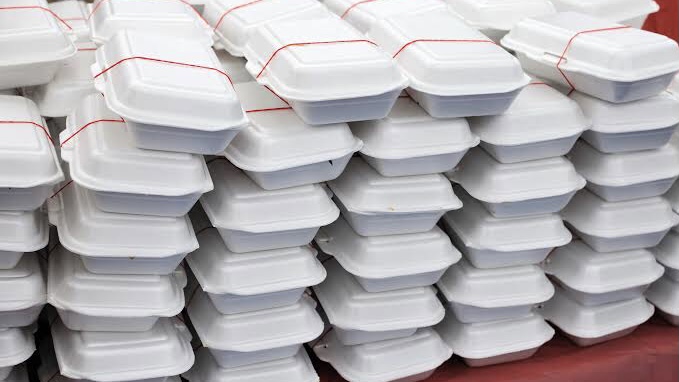
Traders have continued to count their losses about five months after the Lagos government banned styrofoam products. The ban has created two opposing camps: traders, whose businesses were heavily hit, and environmentalists, who insist that the policy is necessary to protect public health and the environment.
A survey across markets and food vending points in Lagos revealed concerns over rising packaging costs, limited alternatives, and gaps in enforcement and public awareness. Cynthia Ofoji, a trader dealing in foam and plastic food packs, said the ban has severely affected her business. According to her, a pack of 100 Styrofoam pieces previously sold for ₦3,800, while the cheapest plastic alternatives now range from ₦11,000 to ₦14,000.
“The small plastic pack is ₦11,000, and the normal size is ₦14,000. The ban has led to a drop in sales. Customers prefer the cheaper styrofoam, but the government does not want us to sell it,” she said. At a popular night market in Ikorodu, a food vendor, Iyabo Adebayo, who sells noodles, expressed similar frustration. Ms Adebayo said she relies heavily on styrofoam containers, noting that plastic options were too costly.
“Customers complain when I increase the price because of packaging. I don’t have affordable alternatives,” she said. Another trader at Oshodi Market, who pleaded anonymity, said some traders are still struggling to face reality. The trader said styrofoams are still being sold in the market through undercovers.
“Styrofoams are wrapped in different covers and hidden inside other goods to avoid the wrath of the law. It’s only the seller and the customer who know how to go about it to avoid being arrested by the Lagos State Government officials during an enforcement raid,” she said.
Similarly, at Abule Market, Ajao Estate, petty traders, such as tomato sellers, still tie their markets with small black nylon. A tomato seller, Abu, said he was aware of the ban but had been struggling to find alternatives to no avail. Mr Abu said that the traders would only comply if the government provided the necessary alternatives. Despite traders’ concerns, some experts have welcomed the ban. Omodara Precious, a microbiology student at the University of Lagos, said styrofoam poses serious environmental and health risks.
“It takes a long time to degrade, blocks drainage systems, and releases toxins when heated. It is also unsafe for microwaving,” he said. The measure has also affected related packaging materials.
Abimbola Omotola, who sells nylon and polyester, noted an increase in the production of thicker nylons, while some lighter variants were no longer in circulation as manufacturers adjusted to new regulations.
To succeed, Emmanuel Ajishafe, a mechanical engineer from Ikorodu, stressed the need for stronger public sensitisation and improved waste-management systems.
“The ban will not work without proper waste disposal routines. Government must invest in more waste management infrastructure and provide affordable alternatives for small businesses,” he said.
He urged authorities to support recycling initiatives and ensure that the transition away from styrofoam does not cripple micro-enterprises already struggling with rising operating costs.
On July 1, 2025, the state began full enforcement of the ban on single-use plastics (plastics under 40 microns), targeting styrofoam food packs, disposable cups, plastic straws, cutlery, and lightweight nylon bags, among others. The commissioner for environment and water resources, Tokunbo Wahab, said this at a news conference that any store found storing or selling SUPs would be sealed, and warned everyone to desist from such an act.
“There will be no going back from July 1 on the enforcement of the ban on single-use plastics, which is less than 40 microns in Lagos state. The Lagos government has put in place different enforcement strategies to effect this ban. However, these strategies have not yet been disclosed.
“Let me also emphasise that any market or store that is found storing or engaging in the sale and distribution of the SUPs less than 40 microns will be sealed up and items confiscated. The offenders will be punished according to the environmental laws of Lagos state,” he said. The commissioner said the ministry had raised widespread awareness of the ban.
“When we announced the ban of styrofoam food containers in January 2024, we also informed everyone that starting from January 2025, certain categories of SUPs will be banned,” added Mr Wahab. “By January 2025, after a series of meetings and representations with concerned stakeholders, the state gave another grace of six months, which expired on July 1.
He added that the decision to ban was mainly due to the safety and well-being of Lagos residents, which would not be compromised. Also, the government has initiated the Plastic Waste Management Fund, a public-private partnership, to support collection, recycling, and waste-management efforts alongside the ban. NAN
-

 Oil and Gas1 day ago
NUPRC vows not to approve divestments that doesn’t meet considerations
-

 Oil and Gas1 day ago
Iran eases Strait of Hormuz transit rules amid oil shock
-

 Finance1 day ago
Cardoso seeks collaboration to check cross‑border financial risks
-

 Economy1 day ago
Nigeria to launch trade platform at ports as part of reform push
-
 Finance1 day ago
Court nullifies CBN’s regulatory intervention in Union Bank in 2024, rules it acted beyond its powers
-

 Oil and Gas1 day ago
Court orders forfeiture of $13m linked to Aisha Achimugu’s firm
-

 Oil and Gas1 day ago
Oil falls as reports of 15-point proposal spurs ceasefire hopes