
Finance
Mansur Muktar Briefing instanbul

Lots of resources now tied up in the central bank, Capital releases made that are not spent —– Muhtar
At the ongoing IMF/World Bank meeting, the Minister of Finance Dr. Mansur Muhtar presented Nigeria position to the World at a joint press conference Africa Finance minister held in Istanbul on Saturday Omoh Gabriel was there and brings Vanguard readers Excerpts of the minister presentation.
Thank you very much for giving me an opportunity to share with you Nigeria’s experiences and challenges in relation to the global economic crisis. I’m sure this is important given the size of the country and further it is a major growth driver in the region.
We entered into the crisis really with a very–fairly robust economy, having undertaken reforms and that including and fiscal management in the relation to the management of oil resources as well as the banking sector consolidation. So, growth rates were quite decent, and we have accumulated sizeable reserves of about $62 billion. So, initially really the first-round effects of the crisis we were able to weather those, and, in fact, there was even a sense in Nigeria, a perception that we were immune from the crisis. But progressively, with the collapse of commodity prices, particularly oil prices, and the associated imbalances, supply-demand imbalances in foreign exchange basically began to be reflected sharply in declining reserves and pressures, inflationary pressures, current account deficits and growing challenges in financing government’s budget.
There and then it became evident that we are not at all shielded, and so the first thing that we had to do was to sensitise government functionaries or reorient public thinking so that policy makers will appreciate the need to tackle this. This led to the setting up of the Presidential Steering Committee on Global Economic Crisis, chaired by the President himself, that was really trying to undertake this sensitization and to really agree on a strategy, to build consensus in terms of public policy priorities to tackle the crisis.
In this context, we appreciated the need to continue with efforts to maintain macroeconomic stability, even as we recognised we had to force people to recognise the trade-offs involved. So, after a series of debates, we had to depreciate the naira to maintain some balance. But the key tool for tackling the crisis was to be the budget, and we had programmed a sizeable fiscal deficit to be able to continue to spend in critical infrastructure as well as preserve social spending in particular sectors.
It also forced us to think about diversification of our revenue sources and enhancing efforts really to capture all the revenues, including plugging of leakages. As I said on the public expenditure side, really an appreciation that we need to learn to do more with less. So, cost savings measures were introduced in the budget to forecast or channel spending to critical areas. And, of course, in relation to the implementation of the budget, we have experienced problems and challenges. We have had revenue shortfalls, a 30 per cent shortfall in revenue in the first half of the year, and overall also implementation challenges in part due to implementation and absorptive capacity, delay in starting up the budget.
So, we have lots of resources now tied up in the Central Bank, capital releases that have been made that are not being spent, and we’re pushing hard to really facilitate project implementation. But we are facing another challenge now; banking sector vulnerabilities. We have always had lingering concerns about the strength and soundness of the banking sector. And, you know, because of this recent audit did reveal severe non-performing assets, under capitalisation, governance problems and even solvency issues.
Part of this also, of course, associated with the huge expansion that was recorded during the consolidation exercise and the inability to match it with rapid pace of development of the supervisory and regulatory capacity, but I think also there were risks that were taken–margin loans, speculative activities in lending to buy shares and then the collapse of the capital markets, exposure to oil marketers. We have huge importation of refined petroleum products, using these resources and eventually oil prices crashed or a huge exposure, about N750 billion margin loans, about N900 billion exposure to petroleum marketers.
So issues really about asset quality, liquidity problems and leading to a loss of confidence in the banking sector led the Central Bank to act promptly in injecting capital, in sacking the management of eight of the banks, in beginning aggressive debt collection. We’re working on plans for restructuring and recapitalisation exercise for these banks.
We expect that shareholders will be given time to recapitalise banks and also will are looking for new capital injection from investors from both local and foreign banks, and we would expect that the creation of an asset management company to remove some of the toxic assets and boost liquidity.
We would expect that if in the event that banks cannot be saved we want an orderly exit. That would protect the depositors and the shareholders. And we will also consider government ownership as an interim arrangement depending on the time we are able to get buyers. So these are all options under consideration. In the meantime, efforts are being made to strengthen regulation and supervision, to focus on risk management as well as to foster greater coordination among all the regulatory authorities. Now in this overall context really we have huge–we will continue to face, huge financing gaps to meet our infrastructure needs; and therefore, our resource needs continue to mount and we expect to receive support.
We did get $500 million from the World Bank Fast Track Facility. We had envisaged going to the international capital markets to raise $500 million bond, but we could not do it because of the conditions and this Fast Track facility was very useful and very timely and very appreciative. We have also goten support from ADB. We are discussing a $200 million facility also, Fast Track, fast tracking of IDA facility, so we in this context we pushed for additional resources.
I’m very interested in the discussions, ongoing discussions to really recapitalise these institutions and replenish the concessional resources. I would continue to play an advocacy role in that regard. We will continue to count on these institutions to provide support and in relation in technical assistance, particularly banking sector resolution and supervision, but with–in the case of the World certainly a lot of interest in getting support improve to public expenditure management, because for Nigeria we believe that with the resources we have available we could do much more than we are doing.
At the end of the day, certainly our perception is that–our belief is that and think this should be the case for almost–all other African countries that our destiny should and will be in our hands; that really the key issue is for us to have very strong committed and dedicated leadership, to have basically a disciplined focus, a shared vision that we’re able to spend among our population and to be disciplined in thinking about the changes, policy changes that we need to implement to respond to the crisis as well as to be disciplined in implementing these in a very proactive manner.
To what extent does Governor Sanusi have the full political backing he’ll need to get right to the bottom of his banking reforms.
I can tell you that the central bank governor has the strongest possible backing from Mr. President and the core economic team. We’ve had a series of meetings on his. We are coordinating our efforts. We have a strategic perspective on this issue. We’ve given endorsement to the initial measures that have been taken to restore confidence in the system and the Ministry of Finance and the central bank are working very closely together to ensure that going forward, we’re able to ensure a smooth transition once these issues now in terms of addressing fiscal costs. We have a core team of the chief economic advisor, the governor of the central bank, the Minister of Finance, and the Minister of National Planning who are looking at this on an ongoing basis and we have full consensus in terms of the sets of measures and we have been given assurances that the implementation of these measures will be supported fully and promptly,.
Sir, it is a year or almost a year after the Accra Agenda for Action. I would want to know what are the real levels of commitment in terms of donour countries to the low-income countries in the face of the ongoing global crisis.
I think there has been considerable progress in relation to the increase in the availability of resources available to these countries, in relation to the relaxation of procedures, simplification and streamlining of procedures for accessing these resources, and I think these are very important and significant steps that–going forward. But certainly a lot more needs to be done. We have heard from the World Bank and the African Development Bank their pleas for increased efforts to replenish their capital base to be able to meet up with the growing demands, the new mandates that they have to fill the financing gaps that I experienced.
We’ve heard also efforts being made to get IDA replenishment and within the context of these discussions, of course, ongoing efforts to streamline and harmonize donor procedures.
These are all welcome developments. Of course, there are lots of issues and challenges that have to be tackled and I think part of problem we’re facing also is in the actualization of these decisions although there has been expressed political will. But getting that translated into concrete decisions in terms of getting needed ratification has taken longer than had been anticipated. But I guess at this stage we’ll just have to continue to push towards the realization of this laudable agenda.
Earlier this week IMF Managing Director, Dominique Strauss-Kahn said that there should be a G20 Plus, and the head of the World Bank, Robert Zoellick, said that there should be more voices at the table for the G20. Has there been any movement among countries besides obviously South Africa to be involved in perhaps a greater community and if so, which countries from Africa should be represented at this G20 Plus besides South Africa?
Obviously, I have my own view on this subject. But on a more serious note, we’ve really been clamouring for greater involvement and this grouping, important grouping, where major decisions that impact on the lives of millions are taken. And we did make some progress on an informal basis in the context of last year’s G20 deliberation or this year actually. We heard–we are given the opportunity to make contributions as a group of ministers and governors of central bank, what we call C10, Committee of 10, that was spearheaded by the African Development Bank, and we have been able to interact, given a platform to interact with key decision makers–Prime Minister Gordon Brown’s initiative to get us–provide input into this and even at least be present at the meeting and being represented by the Prime Minister of Ethiopia and I believe the–some of the heads of the regional development agencies.
But within that context, we have been asking for more formal representation at that level. For us, at the moment, the key concern is to ensure that this principle gets accepted.
And we are very delighted to see a softening of view of opinion in this regard, and we would–certainly the second stage obviously once that decision is taken is to decide on representation. And again, we are open. I think the basic principle is we want to ensure the most effective representation. And, of course, I do know that in a different context, we have been discussing some of the key considerations that need to be taken into account in relation to having this effective representation. And part–first, of course, is the capacity to be able to make a contribution and secondly the ability to liberate the very political clout that a country enjoys and thirdly perhaps the leadership role. If, for example, a county is playing in a leadership role in terms of regional integration that would help a lot in ensuring that the continent is effectively represented.
But at the end of the day, of course, this has to be arrived at by consensus, and I’m sure given the opportunity African leaders would be able to reach a decision on this matter.
-
 Oil and Gas1 day ago
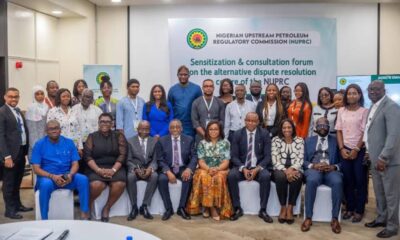
NUPRC vows not to approve divestments that doesn’t meet considerations
-
 Oil and Gas1 day ago
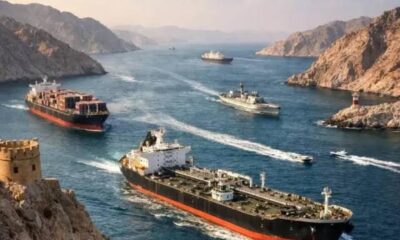
Iran eases Strait of Hormuz transit rules amid oil shock
-

 Finance1 day ago
Cardoso seeks collaboration to check cross‑border financial risks
-

 Oil and Gas1 day ago
Court orders forfeiture of $13m linked to Aisha Achimugu’s firm
-
 Oil and Gas1 day ago
Oil falls as reports of 15-point proposal spurs ceasefire hopes
-
 Economy1 day ago
Nigeria to launch trade platform at ports as part of reform push
-
 Finance1 day ago
Court nullifies CBN’s regulatory intervention in Union Bank in 2024, rules it acted beyond its powers