
Agriculture
Nigeria, 11 others to benefit from smallholder agriculture fund

Nigerian smallholders’ farmers and those from 11 other Africa countries are to benefit from the Global Environment Facility launched an innovative $106.5 million pilot program for fostering sustainability and food security in Sub-Saharan Africa.
The twelve Africa dry-land countries are Nigeria, Burkina Faso, Burundi, Ethiopia, Ghana, Malawi, Niger, Kenya, Senegal, Swaziland, Tanzania, and Uganda.
According to GEF these dry-land regions face the greatest threat of environmental degradation in smallholder farms, and are therefore well placed to harness good practices for sustainability and resilience such as soil and water conservation, diversification of farmlands, and integrated management of crops and livestock.
GEF financing for the program will be driven by the priorities of the participating countries, primarily in the context of baseline investments addressing the needs of smallholder farmers. The program it was learnt will enable creation or strengthening of institutional frameworks to promote integrated approaches in smallholder agriculture; promote scaling-up of interventions for sustainability and resilience; and ensure effective monitoring of ecosystem services and global environmental benefits through application of innovative tools and practices.
Mr. Richard Lerisien Lesiyampe Council member from Kenya in endorsing GEF’s integrated programmatic approach and innovative thinking said “The whole world must develop a framework for food security; this working program is so significant it will go into the annals of the GEF.”
The Global Environment Facility said it has launched an innovative $106.5 million pilot program for fostering sustainability and food security in Sub-Saharan Africa in response to the growing pressure to transform African agriculture through intensification with high inputs and high yielding varieties that will likely undermine sustainability of the natural capital.
According to the body “By integrating environmental priorities at scale, the program entitled Fostering Sustainability and Resilience for Food Security in Sub-Saharan Africa will enable smallholder farmers in the dry-land regions of Sub-Saharan Africa ensure the sustainability and resilience of production systems”.
Naoko Ishii, CEO and Chairperson of GEF said “Sustainability of the natural capital — land, water, soil, trees, and genetic resources — that underpin food and nutrition security, must be ensured by bridging the gap between traditional and modern farming practices. Smallholder agriculture, which accounts for more than 70 percent of agricultural production in Sub-Saharan Africa, can benefit from a holistic approach to management of natural capital.”
It was learnt that the total GEF financing of $106.5 million will be supplemented by $805.36 million co-financed from the governments, development agencies, foundations, international organizations, and the private sector. IFAD is the lead GEF agency for the program, and seven other GEF Agencies (CI, FAO, IFAD, UNDP, UNEP, UNIDO, and World Bank) will support the individual country projects.
-
 Oil and Gas1 day ago
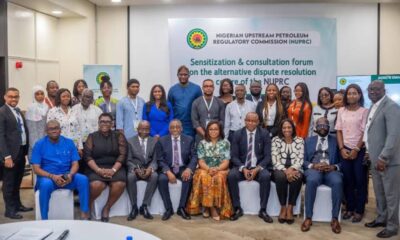
NUPRC vows not to approve divestments that doesn’t meet considerations
-

 Oil and Gas1 day ago
Iran eases Strait of Hormuz transit rules amid oil shock
-

 Finance1 day ago
Cardoso seeks collaboration to check cross‑border financial risks
-
 Economy1 day ago
Nigeria to launch trade platform at ports as part of reform push
-

 Finance1 day ago
Court nullifies CBN’s regulatory intervention in Union Bank in 2024, rules it acted beyond its powers
-

 Oil and Gas1 day ago
Court orders forfeiture of $13m linked to Aisha Achimugu’s firm
-

 Oil and Gas1 day ago
Oil falls as reports of 15-point proposal spurs ceasefire hopes