
Business
Nigeria authorises deployment of 5-G Network

The Federal Executive Council (FEC) has approved the policy on deployment of Fifth Generation network, popularly known as 5-G. The Minister of Communication and Digital Economy, Prof. Isa Pantami, made this known to State House Correspondents at the end of the council meeting presided over by President Muhammadu Buhari in Abuja on Wednesday. According to the minister, the new network will help open up opportunities in the economic, educational and health sectors, adding that security agencies will also benefit a lot from the network.
Pantami said “I presented a memo before the Federal Executive Council and was approved after deliberation, that is the National Policy on 5th Generation network for Nigeria’s digital economy. That policy has been approved by the Federal Executive Council today. Furthermore, the policy discusses the benefits to be attained through the deployment of 5-G in Nigeria and any part of the world which includes like lower latency, larger capacity and higher date rate. In a simple language we can say it will open many opportunities economically, educationally and even in the health sector, and it will also support our security institutions particularly in areas where they need high quality services.” He noted that the network would have been deployed since last year but there was a lot of outcry from the Nigerian public, which made government to stay action on that to give room for more consultations.
“In the year 2020 there was a time that we started the 5th Generation trial but there were complaints from citizens about the relationship between 5-G and COVID-!9. But because our government is a responsible one, we decided then, to put everything on hold and engage more stakeholders and we spent almost 18 months working on that. We also waited for the resolution or verdict of the two most important organisations globally when it comes to the deployment of telecommunications facilities. These are the International Telecommunications Union (ITU) and the World Health Organisation (WHO), which are both arms of the United Nations.
Both of them confirmed that there is no any adverse health hazard associated with 5-G, and it has not been proven to be harmful to human health. Most importantly, even its frequency and radiation is even lower than that of 4-G and the electronic gadgets like the television sets and microwaves we use at home. So they have already issued that explanation about its safety. “They also advised nations on the standards and regulations they use in the course of its redeployment,”he further explained.
He said the Nigerian Communications Commission (NCC) had been directed to comply with all the regulations and standards specified by the ITU and WHO. Furthermore, in order to create awareness and sensitise our citizens, the Nigerian Communications Commission has been reaching out to citizens through local languages to tell them the advantages of 5-G,” he said. He said the deployment of the network would be in phases, as it will start with major cities of the country, where there is need for high quality broadband, between now and 2025. Meanwhile, the Technical Assistant on Information Technology to the minister, Dr Femi Adeluyi, has assured in a statement that government would continue to engage all stakeholders on the policy.
-

 Economy2 days ago
Global Economy Endures War Shock So Far–Georgieva
-

 Economy2 days ago
Manufacturing sector paid N329.59bn to FG as VAT; company income tax net N1.37trn in Q1 2026—NBS
-
 News2 days ago
FG, States, LGs shared N2.26trn as April FAAC allocation
-

 News2 days ago
Afreximbank cancels annual meeting on Ebola concerns
-

 Agriculture2 days ago
AFC backs $7bn Dangote Fertiliser expansion to strengthen Africa’s food security
-
 Economy2 days ago
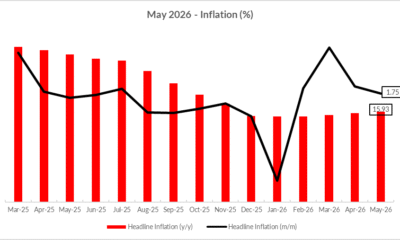
Nigeria’s inflation rate inches up to 15.93% in May, CPPE attributes rise to impact of geopolitical tensions in the Middle East
-

 News15 hours ago
Cooking gas prices may crash to N900/kg by end of 2026, says NALPGAM
-

 News15 hours ago
Mobile tech to add $290bn to Africa’s economy by 2030— GSMA