
Maritime
Nigeria eyes major economic growth in 2023 – SGF Mustapha

Taking the maritime sector as economic anchor, the Federal Government says it is targeting placing Nigeria among the first 70 countries in the World Bank Ease of Doing Business index, a most sought-after economic feat globally, by 2023. The Secretary to the Government of the Federation (SGF), Mr. Boss Mustapha, stated this Saturday night in Lagos at the third edition of the annual Corporate Dinner and Merit Awards organised by the Nigerian Maritime Administration and Safety Agency (NIMASA). That projection came as Minister of Transportation, Rt. Hon. Chibuike Rotimi Amaechi, said the transportation sector was being developed as a strategic driver of the President Muhammadu Buhari administration’s economic diversification and growth agenda. Amaechi said the government was focused on the establishment of a strong intermodal transport system that would facilitate seamless movement of goods and people and drastically reduce the cost of transportation and business, generally.
Mustapha, who chaired the evening of honours for outstanding maritime players, said recent improvements in the Nigerian maritime industry had positioned it as a viable guarantee of economic growth and wealth creation. He disclosed with delight that Nigeria had moved from 170 to 131 in the global ease of doing business table since Buhari established the Presidential Enabling Business Environment Council (PEBEC) in July 2016. The council was set up to remove bureaucratic constraints to doing business in Nigeria and make the country an increasingly easier place to start and grow a business. Mustapha said the PEBEC initiative, coupled with significant developments in ports and maritime, had engendered great improvements in ease of doing business in the country. “In our bid to improve efficiency and productivity in the maritime industry and the country at large, the PEBEC was created to ensure an enabling environment for port efficiency. Government will continue to support the maritime sector because on it rests opportunities for wealth creation and economic growth,” he stated. On his part, Amaechi said with a developed transport sector, “There will be increased productivity, which comes with creation of more jobs and production of more goods and services. All these will make the economy more competitive, reduce dependence on oil, and usher in economic growth. This is our target.”
According to him, “We are aware that transportation is key in any economic development plan. The major elements of production – raw materials, machines, people, finished products, etc. – have to be seamlessly moved from one point to the other as the need arises. The President Muhammadu Buhari government is implementing a transport policy, which entails linking all seaports in the country by rail, in line with global best practices. All over the world, the most efficient way to transport heavy cargo is by water and rail. We have a 25-year rail modernisation programme, involving the development of a comprehensive intermodal system. We are taking the rail from where the past governments stopped to the seaports. The Lagos-Kano rail line, which began from Ebute Metta, is being taken from Ebute Metta to Apapa seaport. We will take it from Tin Can and Apapa to connect the new Lekki port. The rail line from Lagos to Calabar links Port Harcourt, Onne, and Warri seaports. Our goal is to have a system where importers would bring in their goods and load them on the rail that takes them to the hinterland, thus, easing the pressure on the roads and increasing their longevity.”
On the economic significance of transportation, Amaechi said, “Adequate investment in transport infrastructure will enhance the efficiency, reliability, and capacity of the transportation system, which will, in turn, lead to lower transport costs, shorter transit times, increased business efficiency, and business expansion, as money previously spent on transport is ploughed back into business.” In his welcome address, the Director-General of NIMASA, Dr. Dakuku Peterside, noted the significant change in the reputation of the Agency in the last few years. Dakuku said the burnished image was part of the fruits of the Management’s deliberate effort to change the old ways of doing things in the industry and the Agency, for the overall good of the economy. He highlighted some of the achievements of the Agency in the last three years to include the Final Billing regime, which has significantly reduced turnaround time for all vessel billing transactions from reduced turnaround time for all vessel billing transactions from between five and 10 years to two weeks of the ship’s departure; increased tonnage, with Nigeria currently placing second in Africa, after Liberia; and reduction of turnaround time for issuance of Sailing Clearance from about one year to 14 days.
Other achievements of the Agency, according to Dakuku, include digital transformation; improved maritime safety, security, and domain awareness; the tripartite agreement by maritime stakeholders, which has ensured harmonious labour relations in the industry; renewed capacity building drive through implementation of a five-year Cabotage cessation plan; and enhancement of the Nigerian Ship Registry. Highlights of the occasion included the conferment of awards to outstanding maritime industry players and staff of NIMASA. One hundred and eighty one staff of the Agency bagged long service awards for 15-30 years of service, with Mrs. Constance Omagbemi getting the coveted Employee of the Year. GAC Shipping Company won the Overall Shipping Company of the Year, among eight awardees of the Industry Stakeholders Merit Award. They were Total Exploration and Production Company, AP Miller Terminal, Tin Can Island Container Terminal (TICT), and the Maritime Academy of Nigeria (MAN), Oron.
Others were West African Ventures, Awaritse Nigeria Limited, and Sea Navigation International Limited. Six state governors graced the occasion, including the host governor, Mr. Babajide Sanwo-Olu, of Lagos State, who came with his deputy, Femi Hamzat, Governor Simon Lalong of Plateau State, Dapo Abiodun of Ogun State, Abubakar Sani Bello of Niger State, and Godwin Obaseki of Edo State. Governor Inuwa Yahaya of Gombe State was represented by the Deputy Governor, Manassah Daniel Jatau. Other dignitaries included Chairman, Senate Committee on Marine Transport, Senator Danjuma Goje, who represented Senate President Ahmad Lawan; Chairman, House of Representatives Committee on Maritime Safety, Education and Administration, Lynda Ikpeazu; Minister of State for Health, Senator Olorunnimbe Mamora; Managing Director, Nigerian Ports Authority (NPA), Hadiza Bala Usman; and Managing Director of National Inland Waterways Authority (NIWA), George Muoghalu.
-
 Oil and Gas1 day ago
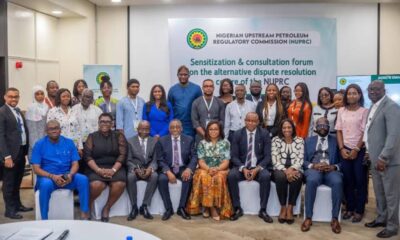
NUPRC vows not to approve divestments that doesn’t meet considerations
-
 Oil and Gas1 day ago
Iran eases Strait of Hormuz transit rules amid oil shock
-

 Finance1 day ago
Cardoso seeks collaboration to check cross‑border financial risks
-

 Oil and Gas1 day ago
Court orders forfeiture of $13m linked to Aisha Achimugu’s firm
-

 Oil and Gas1 day ago
Oil falls as reports of 15-point proposal spurs ceasefire hopes
-
 Economy1 day ago
Nigeria to launch trade platform at ports as part of reform push
-
 Finance1 day ago
Court nullifies CBN’s regulatory intervention in Union Bank in 2024, rules it acted beyond its powers