
Maritime
U.S. Coast Guard to lift a 12 year entry restriction imposed on vessels from Nigeria

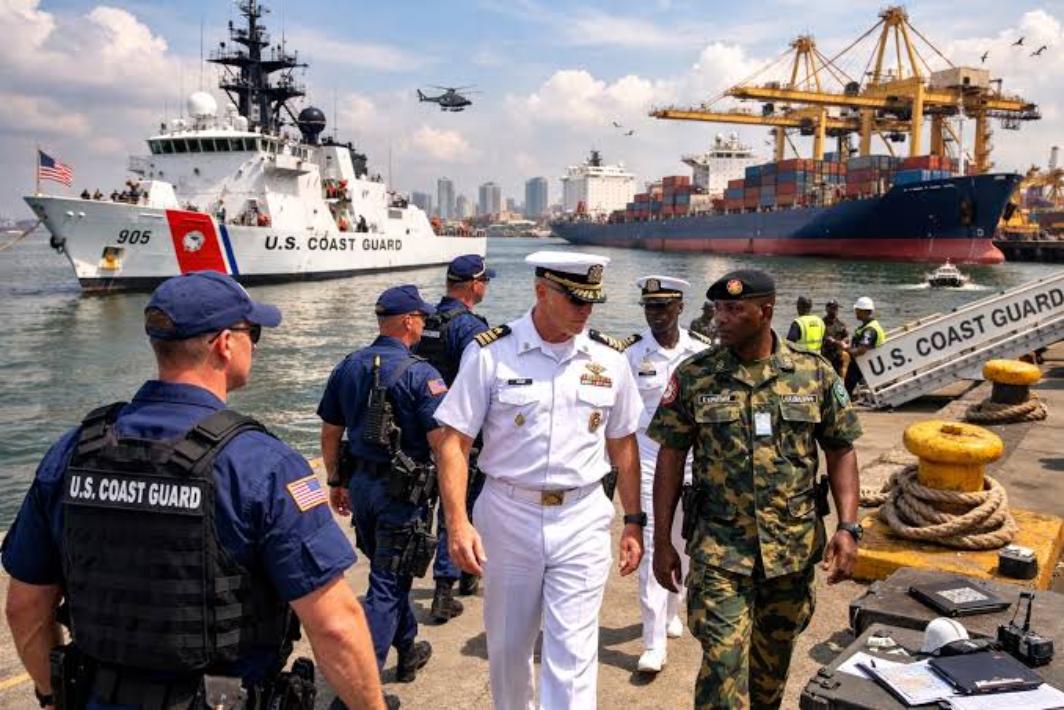
Minister of Marine and Blue Economy, Dr. Adegboyega Oyetola, has announced a major breakthrough in Nigeria’s maritime sector, following the decision by the United States Coast Guard (USCG) to lift the Condition of Entry (CoE) imposed on vessels arriving in the United States from Nigeria.
The development brings to an end a 12-year regime of enhanced security requirements on vessels calling at Nigerian ports before entering the United States and marks a significant milestone in the Federal Government’s efforts to strengthen maritime security, improve port competitiveness and enhance Nigeria’s standing in the global maritime industry.
The Condition of Entry, which took effect on June 25, 2014, required vessels destined for the United States that had called at designated Nigerian ports within their previous five port calls to undergo additional security measures and enhanced scrutiny before gaining access to U.S. waters.
Announcing the development, Dr. Oyetola said the lifting of the restriction was a strong affirmation of the progress made by Nigeria in strengthening its maritime security architecture and implementing the International Ship and Port Facility Security (ISPS) Code across the country’s ports and maritime facilities.
He attributed the achievement to sustained efforts by the Federal Ministry of Marine and Blue Economy, through the Nigerian Maritime Administration and Safety Agency (NIMASA), in collaboration with relevant government agencies, port operators, terminal and facility operators, shipping companies and other stakeholders.
According to the Minister, the coordinated efforts were aimed at strengthening Nigeria’s maritime security framework, addressing identified gaps and demonstrating sustained compliance with internationally accepted maritime security standards.
Over the past two years, the United States Coast Guard conducted four comprehensive assessments of Nigeria’s national maritime security framework and port facilities. The assessments were carried out from March 11–13, 2024; April 15–19, 2024; March 15–21, 2025; and April 13–17, 2026.
The results of the assessments demonstrated significant progress in Nigeria’s maritime security performance and implementation of the ISPS Code, ultimately leading to the lifting of the Condition of Entry.
Dr. Oyetola described the development as a significant achievement for Nigeria’s maritime sector, noting that it reflects the impact of sustained regulatory oversight, institutional collaboration and NIMASA’s commitment to strengthening maritime security.

“The lifting of the Conditions of Entry is a major milestone for Nigeria’s maritime sector. It is a strong affirmation of the progress we have made in strengthening maritime security and implementing the ISPS Code across our ports and facilities,” the Minister said.
“We are committed to sustaining this momentum and ensuring that Nigeria remains a safe, secure and competitive destination for international shipping.”
The Minister also commended the Director-General of NIMASA, Dr. Dayo Mobereola, and his team for their contribution to the achievement, describing the lifting of the restriction as evidence of the positive impact of effective regulation, stakeholder collaboration and sustained investment in maritime security.
Oyetola noted that the significance of the development extends beyond maritime security, with the potential to improve the competitiveness and efficiency of Nigerian ports and strengthen Nigeria’s position within the global maritime economy.
The lifting of the CoE is expected to facilitate faster vessel turnaround and improve schedule reliability, while reducing costs associated with additional documentation, inspections, security measures and entry-related delays.
It is also expected to make Nigerian ports more attractive to international shipping lines, encourage increased shipping activity and contribute to greater trade, investment, employment opportunities and port revenues.
For more than a decade, vessels trading between Nigeria and the United States were subjected to additional security and operational requirements as a result of the CoE.
These measures had implications for shipping operators, including increased security and operating costs, additional inspections and documentation, delays in vessel turnaround, and higher freight and insurance costs.
The restrictions also raised broader concerns about the competitiveness of Nigerian ports and their perception within the international shipping community.
With the lifting of the CoE, vessels calling at Nigerian ports and subsequently proceeding to the United States will no longer be subjected to the additional USCG security requirements imposed specifically under the restriction.
-

 Economy2 days ago
Nigeria Sovereign Investment Authority announces winners of $275,000 prize for innovation
-

 Finance2 days ago
Airtel Money reports 25% growth in first-half revenue in maiden results
-

 Oil and Gas2 days ago
Honeywell Technologies launches new AI platform at Dangote’s Nigeria refinery
-

 Economy2 days ago
FG targets single-digit inflation by end-2027 to unlock cheaper borrowing— Oyedele
-

 News2 days ago
EFCC arrests 14 Chinese nationals in Nigeria for operating illegal lithium processing plants
-

 Maritime2 days ago
NIMASA, ITF signs MOU on Seafarer wellbeing, MoU First in Africa—ITF
-

 News14 hours ago
Nigeria panel says 37 detained miners died from overcrowding and neglect
-

 Finance14 hours ago
UBA seeks jail term for WEMPCO directors, intensifies N61bn loan recovery drive