
News
UK regulatory Chief, Russell lauds NQP implementation in Nigeria

Chief Executive of the United Kingdom Office for Product Safety and Standards (OPSS), Graham Russell has lauded the Nigerian approach to implementing the National Quality Policy (NQP), describing it as novel.
Mr. Russell made the assertion during the OPSS International Conference 2026, held in London between January 27 and 28th, 2026 with the theme “Regulation for Growth – Product Regulation in a Digital Age”.
According to him, the Nigerian governance structure which has an inter-ministerial body domiciled in the Presidency, responsible for coordinating the implementation would be an interesting case study for other countries concerned with strengthening their quality infrastructure (QI) pillars through the implementation of a quality policy.
He was responding to a presentation on “Innovation and Nigeria’s National Quality Policy” made by the Chairman of the National Quality Council, Osita Aboloma at the session on “Innovation, Regulatory Delivery and Data Handling”.
Mr. Aboloma alluded to Nigeria being one of the few Nations with a distinct governance structure for the implementation of its approved NQP, stressing that the policy provides for private sector participation in the quality infrastructure value chain with regards to product inspection and conformity assessment that were hitherto dominated by government institutions and agencies.
He disclosed that working in partnership with the British Standards Institution under the Standards Partnership programme, Nigeria has adopted a multi-faceted but prioritized series of interventions to address QI implementation issues including; the sensitization of the role of the policy in making QI more efficient and focused within Government and key stakeholders, especially in the private sector; the completion of a NQP Implementation Strategy Matrix based on key sectors identified by the Nigeria Export Promotion Council (NEPC), namely: Cocoa, Cashew, Leather and its derivates as well as Tea as pilot projects; development and implementation of a NQP communications strategy as part of launching and promoting the role of the NQP, especially within the private sector
These according to the NQC Chief Executive, have provided opportunity for successful engagements and interactions with the government regulatory fraternity as well as the organized private sector groups, including small and medium scale enterprises.
Aboloma stated that one of the most significant deliverables in the NQP implementation in Nigeria so far was the Nigerian National Accreditation System (NiNAS)’s recent achievement of Mutual Recognition Arrangement of the African Accreditation Cooperation (AFRAC) and International Laboratory Accreditation Cooperation (ILAC) as well as the multilateral arrangement of the International Accreditation Forum (IAF).
The achievement according to him has provided Nigeria with a local equivalent of an international trade instrument for trust and integrity in the form of accreditation that is recognized globally, with great prospects for foreign exchange savings and job creation in the quality infrastructure value chain.
The NQC according to him, is in the process of developing a National Technical Regulatory Framework (NATReF) using the approved African Technical Regulatory Framework (ACTReF) as reference material. “When fully operational, the NATReF is expected to significantly improve Nigeria’s technical regulatory space as well as enhance our data handling using digital solutions” he said.
Aboloma stated that these would culminate into Nigeria’s pioneering role in implementing the mutual recognition agreement under the African Continental Free Trade Area Agreement (AfCFTA), an instrument to promote equivalence using conformity assessment as a vehicle across the continent. Africa Infrastructure Financing Facility Launched to Strengthen Continental Financial Sovereignty
African Heads of State and Government on February 14, 2026, formally launched the Africa Infrastructure Financing Facility (AIFF), a coordinated, Africa-led platform designed to accelerate the preparation and facilitation of financing for priority cross-border infrastructure projects aligned with Agenda 2063.
The launch took place during the Third Presidential High-Level Dialogue of the Alliance of African Multilateral Financial Institutions (AAMFI), convened on the margins of the 39th African Union Summit under the theme: “Strengthening Africa’s Financial Architecture to Finance Agenda 2063.”
Held under the patronage of H.E. John Dramani Mahama, President of the Republic of Ghana and African Union Champion on AU Financial Institutions, the Dialogue reinforced Africa’s commitment to translating financial sovereignty into operational mechanisms capable of mobilizing long-term capital at scale.

Agenda 2063 continues to face financing constraints driven by fragmented capital markets, elevated cost-of-capital premiums, limited long-term funding, and persistent reliance on external financial systems that do not fully reflect Africa’s development realities. Against this backdrop, African leaders emphasized the need to strengthen existing African Multilateral Financial Institutions (AMFIs) while accelerating the operationalization of African Union Financial Institutions.
“Africa has domestic capital pools exceeding $2.5 trillion,” President Mahama stated. “The challenge is not the availability of capital, but how intentionally we deploy it into infrastructure, industrialization, and job creation to realize Agenda 2063 and the African Continental Free Trade Area.”
He underscored the importance of reducing dependency on fragmented financing systems that misprice Africa’s risk and called for a coherent continental financial architecture capable of financing Africa’s development sustainably.
Representing the African Union Commission, H.E. Mrs. Francisca Tatchouop Belobe, Commissioner for Economic Development, Trade, Tourism, Industry and Minerals, reaffirmed the AU’s commitment to strengthening continental financial coordination:
“The launch of the AIFF is a powerful demonstration of what can be achieved when political will and institutional coordination converge. We are confident that this Facility will contribute meaningfully to closing Africa’s infrastructure financing gap, estimated at approximately US$221 billion annually over the period 2023 to 2030.”
Delivering the opening remarks, Samaila Zubairu, President & Chief Executive Officer of Africa Finance Corporation and Outgoing Chairman of AAMFI, underscored the importance of coordinated African capital deployment:
“The Alliance of African Multilateral Financial Institutions represents over $70 billion in balance sheets, working together to close Africa’s trade, investment, and development financing gaps. Our collective action is central to mobilizing the resources needed to deliver transformative infrastructure and regional integration.”
He emphasized that Africa’s development ambitions require scale, institutional alignment, and disciplined capital mobilization to close infrastructure and industrial financing gaps.
Highlighting the importance of the Facility, Dr. George Elombi, President and Chairman of the Board of Directors of Afreximbank said: “The Africa Infrastructure Financing Facility has been designed to address the most persistent constraint to infrastructure delivery in Africa: the gap between political approval and financial execution.
Too many projects stall not because they lack relevance, but because they are insufficiently prepared, inadequately structured, or misaligned with the requirements of long-term capital. African Multilateral Financial Institutions understand African risk, African markets, and African development realities. By pooling expertise, balance sheets, and risk frameworks, the Facility moves Africa from fragmented interventions to a coherent system capable of mobilising capital at scale.”
Dr. Corneille Karekezi, CEO of Africa Reinsurance Corporation and incoming Chair of AAMFI, emphasized institutional collaboration:
“Africa’s development finance must be anchored in collaboration and innovation. By strategically sharing risk, strengthening our institutions, and mobilizing both domestic and private capital, we can build a resilient financial ecosystem capable of delivering transformative infrastructure and industrial growth across the continent.”
The Dialogue underscored that while political commitment to infrastructure remains strong, projects often face constraints at early preparation stages. Limited project preparation funding, fragmented regional policies, and insufficient coordination were cited as key challenges.
A central highlight of the Dialogue was the formal launch of the Africa Infrastructure Financing Facility (AIFF). Established under a Cooperation Framework Agreement between AUDA-NEPAD and AAMFI, the AIFF provides a structured, Africa-led coordination mechanism to accelerate project preparation and facilitate indicative, non-binding engagement on financing for priority infrastructure aligned with Agenda 2063.
In a further demonstration of momentum toward strengthening Africa’s financial architecture, the Dialogue concluded with the ceremonial deposit of the Instrument of Ratification of the Protocol and Statutes of the African Monetary Fund (AMF) by the Republic of Cameroon.
This milestone reinforces Africa’s ongoing efforts to operationalize key African Union Financial Institutions aimed at promoting macroeconomic stability, providing balance-of-payments support, and enhancing monetary and financial cooperation among African Union Member States.
-
 News2 days ago
PwC, EY jointly command an estimated 35.9% of Nigeria’s corporate audit market in 2025`
-

 Economy14 hours ago
72% of world trade still operates under WTO— Okonjo-Iweala
-

 News2 days ago
Flutterwave makes CNBC, Statista’s World’s top fintech companies list
-

 Oil and Gas2 days ago
Internal documents show Shell’s role in oil theft, environmental damage across Niger Delta
-

 Oil and Gas2 days ago
Oil jumps 7% on escalating Middle East airstrikes
-

 Economy2 days ago
Atiku raises alarm over Nigeria’s N12.62tr debt profile
-
 News14 hours ago
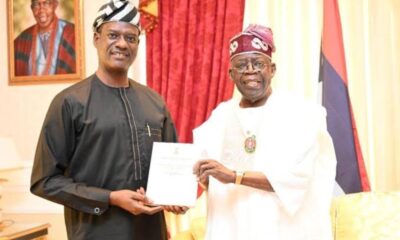
Subsidy savings spent on debt servicing, higher spending—Oyedele
-

 Oil and Gas14 hours ago
Olugboboro community expresses worry over Oando Plc’s decision to halt reclamation project