
Maritime
IMO/GreenVoyage2050: NIMASA rallies stakeholders’ to develop National Action Plan

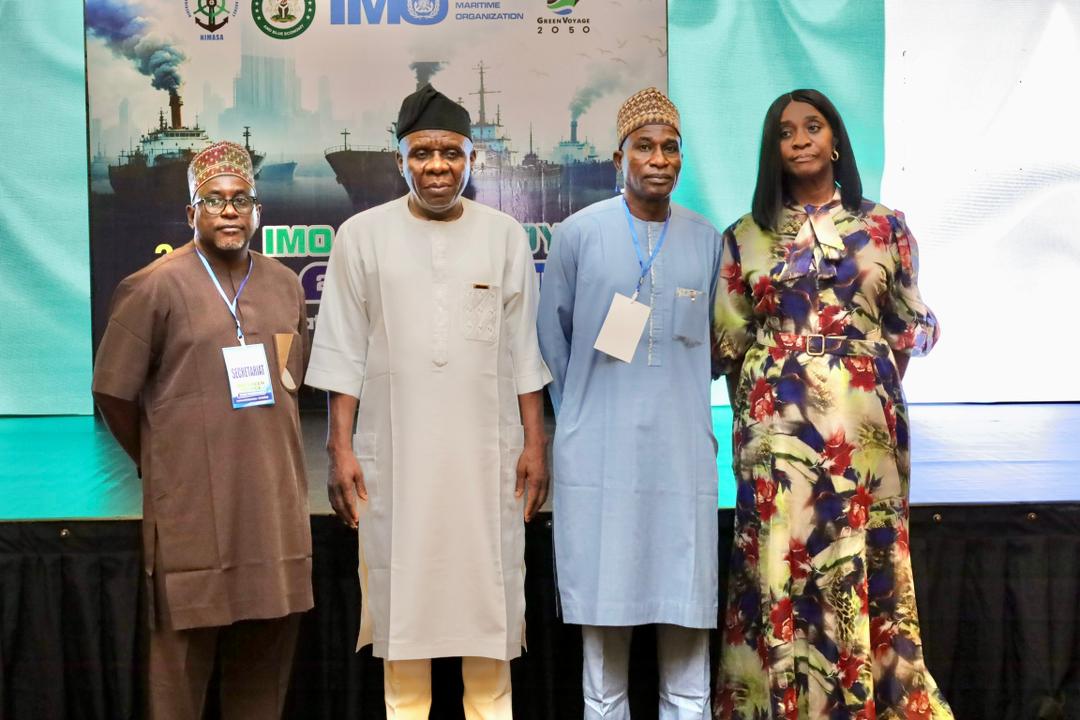
Nigerian Maritime Administration and Safety Agency NIMASA has pledged its commitment to provide the regulatory leadership, technical coordination, and stakeholder engagement required to successfully develop and implement a robust National Action Plan on maritime decarbonization in Nigeria.
The Director General Dr. Dayo Mobereola who made this known during the National Stakeholders’ workshop on the development of a National Maritime Decarbonization Action Plan further described the workshop as a critical step in actualizing the Federal Government’s blue economy and climate objectives.
Represented by the Executive Director, Operations, Engr. Fatai Taiye Adeyemi, the NIMASA DG underscored the significance of the IMO GreenVoyage2050 Project, a technical cooperation initiative /designed to support developing countries in implementing the IMO GHG Strategy.
According to him, the National Action Plan being developed will reflect national realities, leverage existing capacities, address identified gaps, and align with broader economic and environmental priorities of the Federal Government.
Dr. Mobereola stressed that “this transition is not merely about compliance with international obligations, it is about safeguarding our marine environment, protecting public health, strengthening the blue economy, and ensuring that our maritime industry remains competitive and future-ready”, the DG said.

Also speaking at the event, was the Technical Manager of the IMO GreenVoyage2050 Project, Astrid Dispert, who highlighted that the overarching objective of the initiative is to advance a coherent and globally aligned regulatory framework to accelerate maritime decarbonization. She also emphasised that NIMASA plays a pivotal role in driving the project at the national level.
The IMO GreenVoyage2050 Project provides technical expertise and institutional support to assist countries in developing and implementing National Action Plans that promote sustainable shipping practices, encourage investment in clean technologies, and strengthen capacity for long-term emissions reduction.
Through this collaboration, the Federal Government is advancing deliberate steps towards maritime decarbonization, reinforcing its commitment to global climate goals and ensuring a cleaner, greener, and more sustainable future for the sector.
-

 News19 hours ago
Cardoso formally receives Central Bank of the Year Award
-

 Economy20 hours ago
Nigeria’s Digital Boom needs nuclear power partnerships for long-term success
-
Uncategorized19 hours ago
June 12 Democracy Day declaration not enough, as citizens wallow in pain – ActionAid, FG declares Friday public holiday
-
 Oil and Gas20 hours ago
NNPC is house of thieves, fraud; Kyari must be arrested dead or alive to account for N210 trillion—Oshiomhole
-
 Oil and Gas20 hours ago
Dangote Refinery seeks $1bn private placement ahead of planned listing
-
 News20 hours ago
Middle East Conflict sends global growth to lowest rate since COVID-19, WBG to Provide up to $100bn for Affected countries over 15 Months—WBG
-

 News19 hours ago
High cost of cooking gas‘ll negatively impact environment, health, CPPE warns