
Economy
350 Niger’s hidden child miners rescued, thousands more at risk—CSO warns

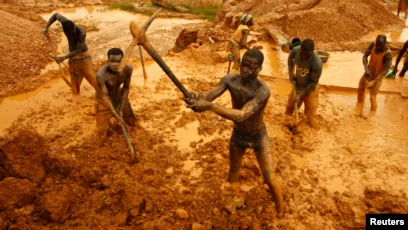
Civil society organisation CSO, have warned that children as young as school age are working at mines pits in Niger alongside adults, missing out on classrooms and childhoods in exchange for the pittance that illegal mining sites offered their struggling families.
It is this quieter, longer-running crisis that a Minna-based civil society organization the Esteemed-Hub Foundation EHF said it has spent years confronting, and one it insists must not be lost in the outrage now trailing the Minna custodial tragedy.
Its Executive Director, Princess Doosugh Agbadu-Adu, said between 2021 and 2023, the foundation implemented the International Labour Organisation (ILO)’s ACCEL Africa programme in Kuchiko, Kukalo and Nakupe in Shiroro and Suleja Local Government Areas, as well as Galadima Kogo in Shiroro, one of the mining corridors of Niger State where child labour has taken root.
At the start of that intervention, EHF profiled 358 children in these communities and found them out of school or never enrolled at all, with insecurity and mining activity identified as key factors keeping them out of the classroom.
By the time the programme wound down, 350 of those children, 170 boys and 180 girls, had been withdrawn from mine sites and mining-related labour, rehabilitated and reintegrated into their communities. Those under 15 were enrolled or re-enrolled in school and given back-to-school kits, while 43 who had reached legal working age were instead placed in vocational training in tailoring, welding, computing, auto mechanics, hairdressing and carpentry, skills the foundation hoped would offer them a livelihood away from the pits.
Alongside the children, 109 parents and caregivers were trained and supported with start-up business equipment and linked to cooperative and financial-inclusion services, an attempt to loosen the grip of household poverty that foundation officials say is what pushes families toward mining sites as a source of child labour in the first place.
“We have withdrawn children from several mine sites in Niger State with our own hands. We know what it takes to prevent this. What we are seeing in Minna is not just a custodial tragedy—it is a reminder of what happens when that work is not scaled to every mining community in this state,” Agbadu-Adu said.
Her comments come as scrutiny mounts over the deaths of 37 detainees arrested during NSCDC operations against suspected illegal mining in the M.I. Wushishi-Lukoto axis of Niger State on September 15 and 16.
The Corps initially attributed the deaths to a suspected disease outbreak but has since said the cause of death remains undetermined pending medical examinations and autopsies. The Minister of Interior, Hon. Olubunmi Tunji-Ojo has suspended the NSCDC’s Niger State Commandant and 20 others. Je has also sey up an independent probe panel, while the Corps’ Commandant General has ordered an internal investigation, and Governor Mohammed Umaru Bago has directed a state inquiry and declared a period of mourning.
For EHF, though, the tragedy is a symptom of a wider, unresolved problem. The foundation said establishing the ages of the 37 deceased is critical, given how well-documented child labour is in mining communities across the state.

It called on authorities to verify and publish the identities and ages of all those who died as part of a credible, independent investigation, one it said should not be substituted by the NSCDC’s internal probe alone.
The foundation also called for the publication of the findings of medical examinations and autopsies once the scientific cause of death has been established.
Agbadu-Adu said the Wushishi-Lukoto corridor, where the fatal incident took place, is exactly the kind of mining-affected community where children remain at risk, and argued that enforcement against illegal mining, however necessary, cannot by itself resolve the conditions pulling vulnerable children into the sites.
“We have withdrawn children from several mine sites in Niger State with our own hands. We know what it takes to prevent this. What we are seeing in Minna is not just a custodial tragedy—it is a reminder of what happens when that work is not scaled to every mining community in this state,” she reiterated, calling for stronger investment in education, child protection and household livelihoods to accompany any crackdown on illegal mining.
The foundation argued that enforcement operations against illegal mining, while necessary, could not by themselves eliminate the conditions driving vulnerable children and families into mining, and said the Minna incident reinforces the case for scaling this kind of community-level intervention across Niger State’s mining-affected communities, including the Wushishi-Lukoto corridor.
It said it remains open to supporting, partnering on, or replicating similar interventions wherever they are needed, whether led by EHF or in collaboration with other organisations and development partners already active in the space, and called on the federal and Niger State governments, development partners, private-sector organisations and other stakeholders to invest in this kind of work at scale.
EHF also called for stronger detention standards and independent oversight of NSCDC holding facilities in Niger State to prevent avoidable deaths in government custody, and urged accountability for any negligence, overcrowding, extortion or human-rights violations established by the investigation.
Even as it pressed for accountability over the Minna deaths, EHF was careful to note that allegations from grieving family members, that detainees were held in overcrowded cells, denied food, and that relatives were asked for payment to secure their release, remain unverified accounts pending the outcome of the inquiry, not established facts. It said allegations should not be treated as established facts before the inquiry is concluded.
“We remain ready to share the results and lessons from our earlier intervention with organisations seeking to combat child labour and expand education and livelihood opportunities in mining communities,” the foundation said.
It expressed solidarity with the families of the 37 deceased and urged the authorities to ensure that investigations into the incident were credible, independent and unhindered.
-

 Economy1 hour ago
Manufacturers still face high production costs despite lower inflation—MAN
-
News44 minutes ago
NDLEA intercepts 1.3m tramadol pills, 6,000kg cannabis worth N3.4bn nabs fake police officer
-
 Uncategorized41 minutes ago
Red Star Express posts stronger profit growth as revenue rises to N23.5bn
-

 Economy10 minutes ago
Retail trade in Nigeria faces stiff foreign competition—CPPE