
Economy
IMF sets up COVID-19 short-term liquidity line to enhance adequacy of global financial safety net

IMF Executive Board said it has set up Covid-19 short term liquidity line to enhance the adequacy of global financial safety net. In a statement the IMF “COVID-19 pandemic has created severe disruption in the global financial system, with many emerging market and developing countries (EMDCs) facing liquidity shortages. In the context of intensified demand for liquidity and heightened global uncertainty, on April 15, 2020 the IMF Executive Board approved a Short-term Liquidity Line (SLL). The SLL is a special facility designed as a revolving and renewable backstop for members with very strong fundamentals and policy track records. It provides liquidity support for members facing potential short-term moderate balance of payments difficulties, reflected in pressures on the capital account and reserves, and resulting from volatility in international capital markets. The SLL aims to reduce the impact of liquidity events and minimise the risk of shocks evolving into deeper crises and generating spillovers to other countries.
Executive Board Assessment1
According to IMF “Executive Directors considered and approved the establishment of the Short-term Liquidity Line (SLL), as part of the Fund’s COVID-19 response. They noted that the SLL would fill a gap in the Fund’s toolkit and complement other layers of the global financial safety net. Directors agreed that the SLL can provide important liquidity support to members with very strong policy frameworks and fundamentals facing potential short-term moderate balance of payments (BOP) difficulties, as specified in the proposed decision. They noted that this could help prevent liquidity pressures developing into solvency crises and avoid spillovers to the broader membership. Despite some differences in views and preferences, Directors were willing to support the proposal in a spirit of compromise.

“Directors broadly supported the core design features of the SLL, built on the work done in 2017. They considered that the revolving access of up to 145 percent of quota should provide cover against most repeated moderate shocks that the SLL is designed to address, and that the availability of successor arrangements, subject to continued qualification and the presence of the special BOP need, would ensure that the SLL is a reliable backstop. Directors also noted that having the same high qualification bar as the Flexible Credit Line (FCL) would facilitate transition from the FCL to the relatively lower access of the SLL, allowing more efficient allocation of Fund resources. A few Directors would have preferred a lower qualification bar and/or higher access. Directors generally supported the innovative features of the SLL designed to minimise perceived stigma associated with Fund financing, including the Board’s approval of an arrangement, conditional on the member availing itself of the arrangement. They recognised the possibility of a Central Bank sole signatory, provided that certain requirements are met, consistent with the Fund’s standards for the signatory of letters of intent or written communications. A few Directors noted that signatures from both the Ministry of Finance and the Central Bank would increase the credibility of the policy commitment. Directors emphasised the need for careful communication in cases where a member ceases to qualify for an SLL arrangement.
“Directors took note of staff’s assessment that SLL usage is likely to have a limited impact on the Fund’s liquidity position. At the same time, some Directors pointed to second-round effects should countries draw on the SLL and no longer participate in the Financial Transactions Plan and/or the New Arrangements to Borrow (NAB). A few Directors also noted the possibility that the SLL could tie up Fund resources for an extended period. Directors recognised that the potential demand for the SLL combined with other Covid-19 related demand for Fund resources could quickly reduce Fund liquidity to levels that would warrant an activation of the NAB. Given these considerations amid the uncertain global outlook, Directors called for closely monitoring the Fund’s liquidity position.
Directors supported the creation of the SLL for a period of 7 years, with an expectation that, by end-2025, the Executive Board will decide whether to extend the facility beyond the 7-year period. They agreed that this compromise approach would balance concerns about the innovative nature of the SLL and the potential impact on Fund resources. Directors looked forward to reviewing the initial experience with the SLL, as part of the next review of the Fund’s FCL and Precautionary and Liquidity Line in 2022”.
-

 Economy2 days ago
CPPE expresses worry over real-sector financing gap of over ₦50trn, proposes new devt-finance architecture
-

 Oil and Gas2 days ago
Energy professionals demand probe of NNPC, NUPRC over transparency concerns
-

 Economy2 days ago
Alake’s media aide debunks claims of handing over Nigeria’s solid minerals to Chinese
-

 Oil and Gas2 days ago
Group urges Ogoni to support resumption of oil production, 33-year shutdown cost Nigeria, Rivers $226bn
-
 Oil and Gas14 hours ago
Oil prices drop 5% to three-week low after Trump cancels attack on Iran
-
Oil and Gas14 hours ago
NNPC remits N6.286trn into federation account between January and June 2026, issues another tender to sell Cawthorne crude
-
 Economy14 hours ago
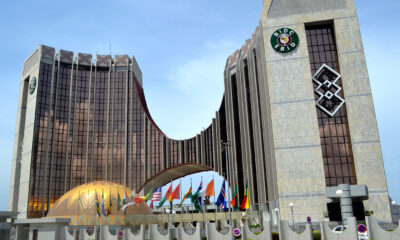
EBID, CORIS Holding sign 80m euro financing agreement to strengthen food, energy, agric value chains in West Africa
-

 News14 hours ago
Breastfeeding can improve Nigeria’s economy—Commissioner